The Avritch Synagogue, also known as the Bat Ayin Synagogue, is the beit midrash of Rabbi Avraham Dov of Avritch (Ovruch), the Hasidic master remembered by the name of his book, Bat Ayin. It stands at the northern edge of the Old Jewish Quarter, and is open on Shabbat and holidays.
The Rebbe who came to Tzfat
Rabbi Avraham Dov was born around 1760 in Khmelnyk, Ukraine, where his father, Rabbi David, was the town’s rabbi. He studied with Rabbi Menachem Nachum of Chernobyl, his son Rabbi Mordechai of Chernobyl, and Rabbi Levi Yitzchak of Berditchev, and served for about forty years as rabbi of Avritch. In 1831, already an old man, he settled in Tzfat. There he led the Hasidic community and founded this beit midrash, which also gave free lodging and meals to travellers, above all to pilgrims on their way to Meron.
The earthquake and the years of trouble
His years in Tzfat were hard ones. In the peasants’ revolt of 1834, rebels looted the Jewish quarter, and he hid with members of his community until they were freed. On 24 Tevet 5597 (January 1837), the great Galilee earthquake struck while he was praying Mincha in this beit midrash. By tradition, he told the worshippers to lie down around him; the walls fell, but the place where they lay stayed standing. Afterwards he led relief and rebuilding and urged the survivors to stay in Tzfat, and in 1840 he founded the city’s burial society.
When an epidemic broke out later that year, he fell ill himself, and is remembered as having said he would be its last victim. He died on 12 Kislev 5601 (December 1840) and was buried in Tzfat’s Old Cemetery. His students included Rabbi Shmuel Heller, who succeeded him as leader of the community, and Rabbi Hillel of Paritch.
A short visit, step by step
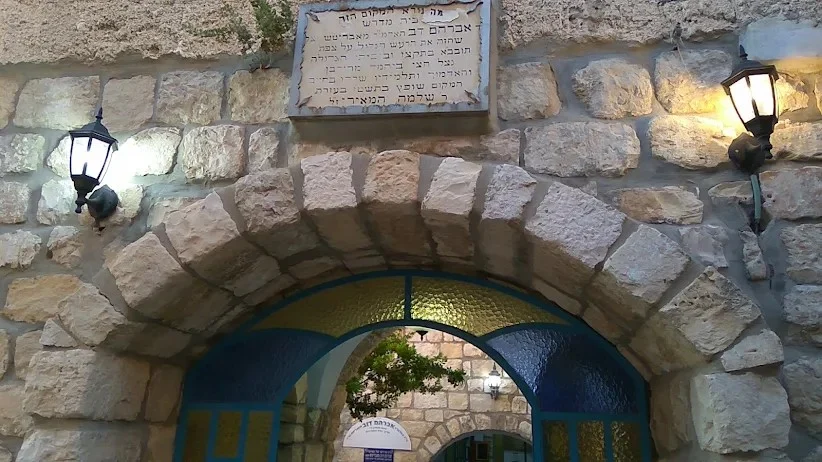
- The arch. You enter under a heavy stone arch between two lanterns. The marble plaque above it is a memorial to the Rebbe, Rabbi Avraham Dov, the Admor of Avritch.
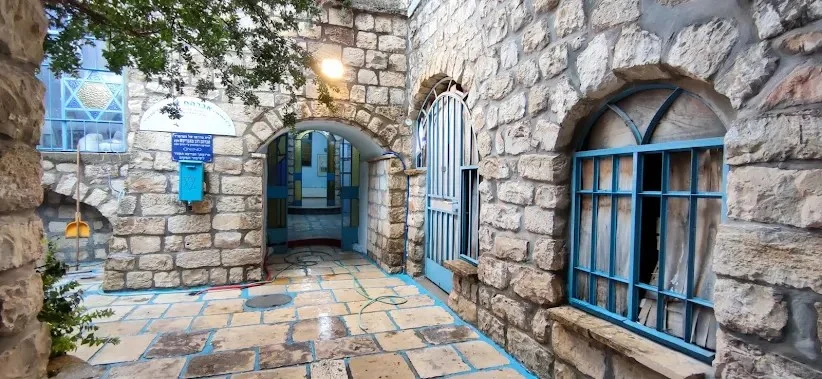
- The courtyard. Inside is a small paved courtyard of Galilee stone, with the blue window frames and doors that Tzfat is known for. Stop here for a moment: this is the house that took in Meron pilgrims nearly two centuries ago.
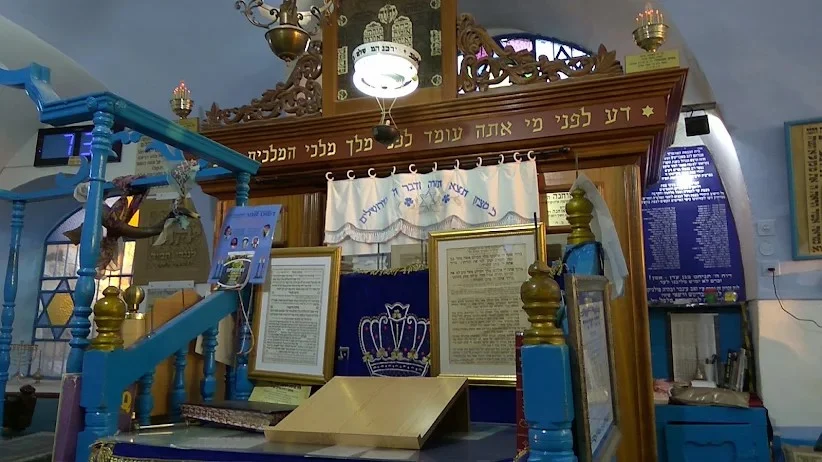
- The ark. In the sanctuary, a blue-painted bimah faces a carved wooden ark. Over it runs the line “Know before Whom you stand: before the King of kings.”
- Remember the earthquake. This is the room where, by tradition, the congregation lay down around the Rebbe in 1837 while the walls came down around them.
- Walk on to his kever. Finish the visit at Rabbi Avraham Dov’s grave in the Old Cemetery, below the Old City, close to the grave of the author of Arvei Nachal.
The book and the hillula
Bat Ayin, written in Tzfat, collects his Hasidic teachings on faith, humility, repentance and prayer, with two halachic responsa, and is still widely studied. His hillula falls every year on 12 Kislev, with Torah study and prayer at the kever and a festive meal; many people hold a “Bat Ayin meal” on that night, a custom tied to stories of deliverance.
Learn more
- bat-ain.info: his life, the full text of Bat Ayin, stories, and the hillula (English, Hebrew, French and Spanish).
- Video (Hebrew): the story of Rabbi Avraham Dov of Avritch, by Rabbi Herzl Hoder.
Sources: bat-ain.info (life of the Bat Ayin; the Tzfat beit midrash); Zissil. Visiting hours can change; check locally before you go.


