 Skip to content
One of the four holy cities
Jerusalem, Hebron, Tiberias and Tzfat — and why Tzfat is called the city of air.
For centuries, Jews in the Land of Israel lived mainly in four cities — Jerusalem, Hebron, Tiberias and Tzfat. Communities around the world sent support to all four, and they came to be known together as the four holy cities.
Tzfat earned its place in the sixteenth century, when Jews expelled from Spain gathered here and the city became the greatest center of Torah and Kabbalah of its age — home to Rabbi Yosef Karo, the Arizal, the Ramak, Rabbi Shlomo Alkabetz and many more.
Four cities, four elements
Sefer Yetzirah, one of the oldest books of Kabbalah, describes the world as built from four elements — fire, water, air and earth. A well-loved teaching pairs each holy city with one of them:
The Temple, its altar and its longing — the fire of devotion.
The Cave of the Patriarchs — rooted in the ground of our ancestors.
On the shore of the Kinneret, city of the Sanhedrin and the Talmud.
High on the mountain — the city of wisdom, Kabbalah and song.
The city of air
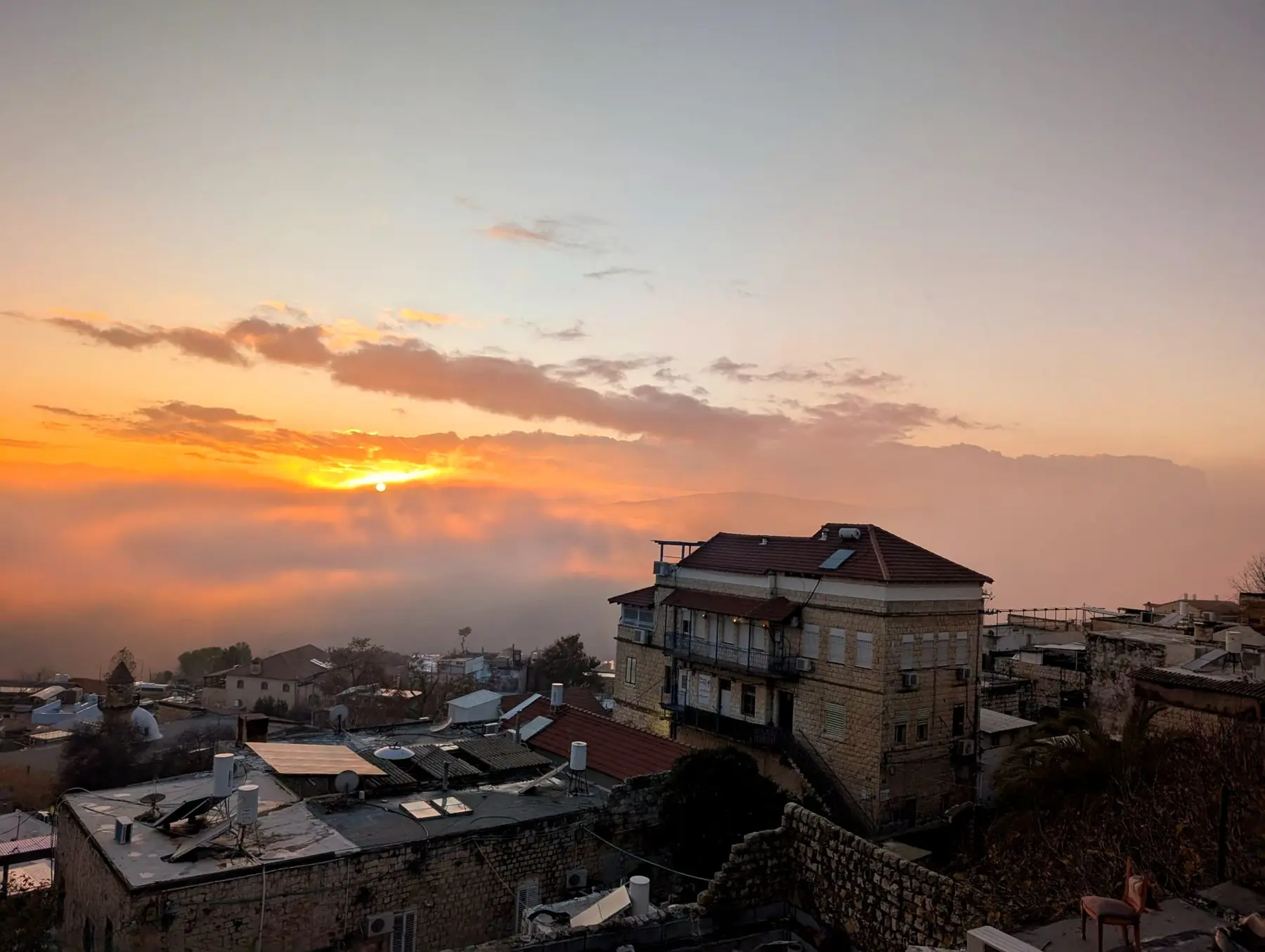
Tzfat sits higher than any other city in the Galilee, on a mountaintop about 900 metres above the sea, with the wind coming off Mount Meron and the hills. Air is the element of breath, speech and inspiration — the space where thought becomes understanding.
The Talmud teaches that “the air of the Land of Israel makes one wise” (Bava Batra 158b). Many feel that in Tzfat this is easy to believe: it was here, in this thin mountain air, that the deepest teachings of Kabbalah were given, and where Lecha Dodi was first sung to welcome Shabbat.
The pairing of cities and elements is a popular teaching built on Sefer Yetzirah’s four elements, not a statement found in one classical source. Sources: Babylonian Talmud, Bava Batra 158b; Sefer Yetzirah.


