The Artists’ Quarter of Tzfat (Safed) is the hillside neighbourhood below the Citadel where, in 1949, Israel’s leading painters moved into the empty stone houses of the old Arab quarter and founded the country’s first artists’ colony. Today it is a maze of blue doors and courtyard studios, home to the General Exhibition in a former Ottoman mosque, two house-museums, and a new generation working in kabbalistic painting, microcalligraphy and Judaica. Ashkenazi speakers say “Tzfas”; older maps write “Zefat” or “Tsfat”.
Where the quarter sits in the Old City
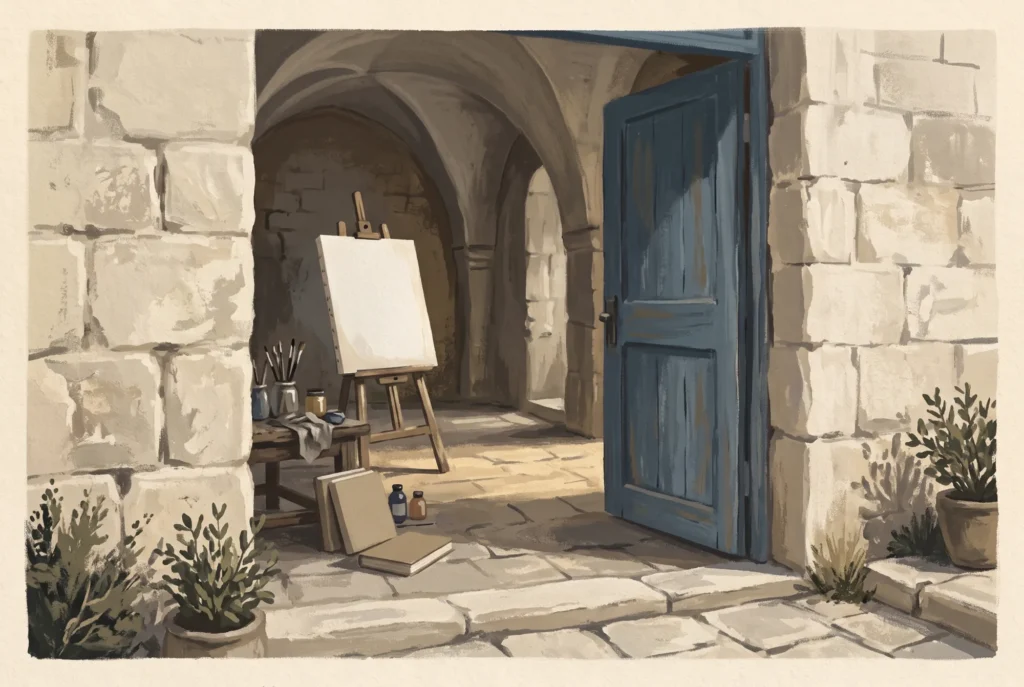
Safed’s Old City is split by a long stone stairway, Ma’alot Olei HaGardom, cut by the British to separate the Jewish and Arab quarters; the date is disputed, with some sources saying after the 1929 riots and others during the 1936–39 Arab Revolt. North of the stairs is the Old Jewish Quarter and the synagogues of the sages of Tzfat. South of it, sloping from the Citadel park down toward the Saraya clock tower, is the former Arab quarter, Harat al-Wata. This is the Artists’ Quarter, Kiryat HaOmanim.
Its spine is Arlozorov Street; the Frenkel and Castel houses stand on Tet Zayin Street just off it, and many houses bear a plaque naming the artist who lived there. The landmarks directory covers the stairs, Citadel and Saraya.
How the colony began (1920s–1949)
Painters found Safed long before 1949. Yitzhak Frenkel first visited in 1920; Moshe Castel and Mordechai Levanon followed in the 1930s. In 1934 Frenkel moved here for good, the first artist to make the town his home, and in 1942 he organised Safed’s first art exhibition, charging one penny at the door.
The colony proper came after the 1948 War of Independence. The Arab residents of the southern quarter had fled, and under the Abandoned Areas Ordinance the empty houses were sold, many to new immigrants. Safed’s first mayor, Moshe Pedatzur, backed the artists, and the municipality invited them to restore ruined houses as studios. The colony’s 1971 album, introduced by a later mayor, Meir Maybar, describes them rebuilding the ruins “with fierce faith”.
The founding core, varying by source: Frenkel, Castel, Menachem Shemi, Shimshon Holzman, Aryeh Merzer and the Lerners; others add Levanon, Ziona Tagger (often called the first woman painter born in the Land of Israel), David Gilboa and Moshe Raviv. They formed the Artists’ Quarter Association; membership required living in Safed and owning property in the quarter. Most sources say 1949; the Jewish Virtual Library says “the early 1950s”.
The mosque that became the General Exhibition
The heart of the quarter is a long, domed hall off Arlozorov Street known as the Market Mosque (Jama al-Suq), because Safed’s weekly market was held beside it. An Arabic inscription over the door dates it to 1901; most guides say 1902, and the arches and foundations beneath are older Mamluk work. It served the town’s Muslim population until 1948.
The municipality then handed the empty building to the Artists’ Quarter Association, which opened it as the General Exhibition (HaTa’arucha HaKlalit), by most accounts in 1952. It has been a cooperative ever since: any member may hang and sell here, even with a gallery of their own elsewhere. Around the courtyard, studios are rented cheaply for limited periods to emerging artists, and there is a café. Entrance is free; hours are roughly Sunday–Thursday 10:00–17:00 (later in summer) and Friday 10:00–14:00.
Inside hangs work by several dozen painters and sculptors, founders to current members. Quality and price range widely, which is the point: see the whole spectrum in one room, then ask for directions to an artist’s studio.
The heyday: Safed versus Ein Hod (1950s–60s)
For two decades Safed was one of the art centres of the young state. Each summer the colony swelled with painters, poets, writers and actors; a Hecht Museum (University of Haifa) exhibition catalogue calls the 1950s and 60s the colony’s period of greatest achievement. Chagall came and painted the religious children; Yosl Bergner and Lea Nikel worked here; more than fifty artists exhibited at the peak.
Two currents met: Frenkel, Holzman and Levanon carried the École de Paris palette into Galilean light, while Castel, Stematsky and Streichman belonged to Ofakim Hadashim (“New Horizons”), the abstract group founded in 1948. Safed was bohemian and nocturnal: nightclubs drew weekend drivers from Tel Aviv.
Ein Hod, on the Carmel, became a colony in 1953 when the Dada painter Marcel Janco persuaded the government not to demolish the village, and it grew into a year-round artists’ village. Safed’s colony was grafted onto an existing town and lived by the season: the Hecht catalogue describes isolating winters and summers when the painters, poets and actors poured in. That difference helps explain what came next.
Decline and the religious-art revival
From the 1970s the founders aged and died: Shemi in 1951, Frenkel in 1981, Holzman in 1986, Castel in 1991. Their children did not want the houses, young artists preferred Tel Aviv, and by the 1980s many galleries simply stopped opening. Locals remember how poor the painters were; one elderly couple’s daily pot of stew fed half the colony.
What replaced them was a different kind of artist. Immigrants from English-speaking countries and later the former Soviet Union restored houses, and the quarter became religious and family-oriented. Many new painters were ba’alei teshuvah (Jews who returned to observance) or Hasidic, and they brought their learning into the studio: the sefirot, the Hebrew letters, the Shabbat table and the tzaddikim of the Old City became subjects in their own right. Today’s artists follow in the footsteps of the mystics as much as of Matisse.
What you will see on the walls today
Microcalligraphy (micrography). Pictures built entirely from minute Hebrew text, often a whole book of Psalms or Genesis in letters you need a magnifier to read. Safed is Israel’s centre of the art, from the watchmaker-painter Shalom of Safed to Moroccan-born artists who learned tiny script as boys so that holy books could be hidden during riots.
Kabbalistic and Hasidic painting. Luminous compositions of the Tree of Life, the four worlds, Lecha Dodi welcoming the Shabbat bride, dancing Hasidim and the domes of the Ari synagogues. Some artists give short talks on the kabbalah behind their work; see learn kabbalah in Tzfat.
Judaica and craft. Silver and olive-wood ritual objects, hand-woven tallitot, blown glass, ceramics, and sculpted beeswax candles, now a Safed signature.
Landscape. Watercolours of the Galilee and Safed’s slanting houses in the manner of Holzman and Frenkel, often by painters who arrived from the former Soviet Union in the 1990s.
The site’s art directory lists current galleries and studios with addresses, hours and languages, updated more often than any guidebook.
Museums in and around the quarter
Frenkel Frenel Museum (Tet Zayin Street). The painter’s house, briefly his art academy in the early 1950s, opened as a museum in 1973: 1920s cubism through the canvases of his last weeks in 1981, plus theatre sets and posters; one relief survives in the courtyard. The press nicknamed it “Frenkel’s Castle”. Opening is irregular, so call ahead.
Beit Castel (Tet Zayin Street 16). Castel’s former home, bought in ruin and rebuilt by Yaacov Hadad, a Safed native who as a boy worked as a helper for Frenkel and Castel. It shows Frenkel, Holzman, Schaffer and Castel beside ancient stone tools the painters dug from the rubble. Listed hours are Sunday–Thursday 10:00–19:00, Friday until noon; it is private, so confirm.
Memorial Museum of Hungarian-Speaking Jewry (HaPalmach Street, behind the Saraya). Founded in 1986 by Hava and Yossi Lustig, opened in 1990 and run by volunteers. Everything was donated: an 1830 wedding lamp, an 1874 coffee set, and the restored Holy Ark of the destroyed synagogue of Tokaj. Five minutes from the General Exhibition.
Hameiri Museum (158 Keren HaYesod Street, at the Breslev neighbourhood, on the Jewish Quarter side). A house with sixteenth-century rooms, once the Sephardi rabbinical court and later a Haganah arms store, which Yehezkel Hameiri (1934–1989) began turning into a museum of Safed’s Jewish life in 1959. Mornings only; sources give Sunday–Thursday 8:30–14:30 (one says Monday–Thursday) and Friday until early afternoon, so confirm.
Three stories worth knowing
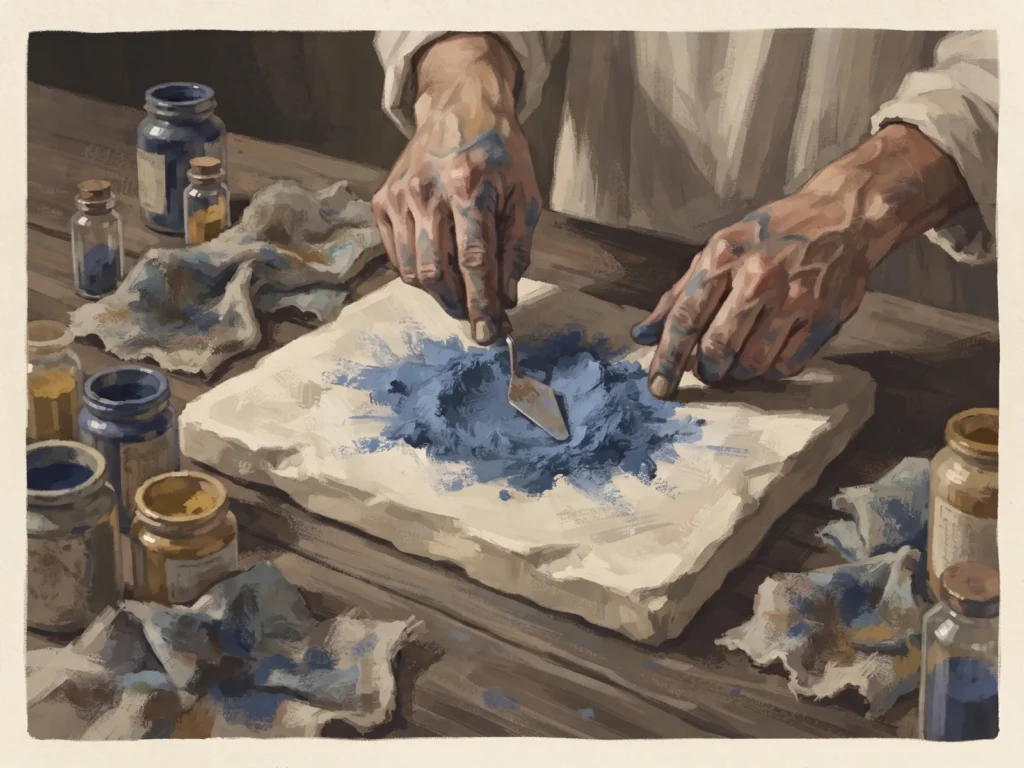
Castel’s crushed basalt. In 1948 Castel visited the ruined ancient synagogue at Korazim above the Kinneret and was struck by its carved black basalt. Around 1950 he began grinding the stone into a paste with sand and glue, to his own formula, and building paintings from it, pressing in archaic letters and signs drawn from Hebrew and Sumerian script. Art, he said, was “not symbolic, but material”. The technique climaxed in his 1966 basalt relief in the Knesset. Castel had spent 1927–39 in Paris, for a time sharing a studio with Alberto Giacometti, before settling in Safed in 1939 (some sources say 1940).
Frenkel’s Paris and the name on the canvas. Frenkel, a great-grandson of Rabbi Levi Yitzchak of Berditchev, reached Paris in 1920 months after Modigliani’s death and studied under Bourdelle and Matisse, exhibiting with Soutine, Kikoine and Pascin. In 1954 he left Safed for France and for six years signed his work “Frenel”, partly to Hebraise it and partly because “Frenkel” was too common. A stained-glass commission for a Normandy chapel set rumours flying that he had left Judaism; they were false. He died in 1981 and is buried in Safed’s old cemetery.
The watchmaker who became Shalom of Safed. Shalom Moskovitz, born in Safed around 1887, mended watches most of his life; locals called him the “Zeigermacher”. His workshop was destroyed in 1948, so he carved plywood toys. Yosl Bergner noticed their craftsmanship and encouraged him to paint, supplying the materials. Late in life Shalom became Israel’s best-known naïve painter, shown at the Israel Museum (1967), the Stedelijk, the Kunsthaus Zürich and MoMA, which owns his Noah’s Ark. He lived in Safed all his life and died here in 1980.
Visiting respectfully: hours, Shabbat, buying and shipping
- Days and hours. Galleries generally open Sunday to Thursday, about 10:00 to 17:00 or 18:00, later in summer. On Friday almost everything closes by early afternoon, earlier in winter, as the town prepares for Shabbat. On Shabbat and festivals the quarter is shut and quiet. Many small galleries open only in spring and summer or by appointment.
- Photography and dress. Ask before photographing inside a gallery or an artist at work. On Shabbat, keep the camera away in the Old City. Modest dress is appreciated, especially if you continue into the synagogues.
- Prices and haggling. This is not a market. Prices for originals are usually fixed; asking about a discount for cash or for two pieces is fine, bargaining hard with an artist in their own studio is rude. Prints and small Judaica are the affordable way in.
- Shipping. Galleries and the General Exhibition pack and ship abroad with an invoice; ask about a certificate of authenticity and VAT-refund paperwork.
- Seasons. After October 2023 the quarter’s galleries were shut for a time by war; it has reopened gradually, so check the events page and the art directory before planning around a specific studio.
A suggested 90-minute gallery walk
- Top of Ma’alot Olei HaGardom (10 min). Walk down the British stairs, Old Jewish Quarter on your right, Artists’ Quarter on your left.
- General Exhibition courtyard (25 min). See the whole spectrum under the domes, peek into the subsidised studios across the yard, and note any artist to follow up.
- Tet Zayin and Arlozorov streets (20 min). The Frenkel Frenel Museum and Beit Castel stand almost next door to each other, with today’s kabbalistic painters and micrographers in the studios between. Read the plaques.
- Up to the Citadel edge (15 min). The lanes above Arlozorov climb toward the park; the view north to Mount Meron is what every founder painted.
- Back across the stairs (20 min). Cross to the Yosef Caro Synagogue and the galleries of Alkabetz Street, then rest at one of the cafés and restaurants in the square.
For a guided version see the tour operators or the site’s audio tours; to sleep among the studios, several guesthouses occupy restored artists’ houses (accommodations).
Keep reading
Frequently asked questions
When was the Safed artists’ colony founded? Most sources say 1949, just after the War of Independence, when Frenkel, Castel, Shemi, Holzman and others formed the Artists’ Quarter Association in the emptied southern quarter of the Old City. Frenkel had lived in Safed since 1934; the cooperative General Exhibition opened, by most accounts, in 1952.
Is the Artists’ Quarter open on Shabbat? No. Galleries close Friday afternoon and stay shut until Saturday night, and on Jewish festivals. Visit Sunday to Thursday or Friday morning. The lanes are pleasant to walk on Shabbat, but the doors will be closed.
Is the General Exhibition really in a mosque? Yes. It is the former Market Mosque, built in 1901–02 on Mamluk foundations and used by Safed’s Muslims until 1948. The municipality gave it to the artists’ association, which has run it as a cooperative gallery since the early 1950s (most accounts say 1952). Entrance is free.
What is Safed microcalligraphy? A picture drawn entirely from tiny handwritten Hebrew text, usually a complete biblical book. Safed became Israel’s centre of the art through Shalom of Safed and later Moroccan-born artists, and several studios still work this way. Originals take months; signed prints are affordable.
Can I buy art and have it shipped home? Yes. Most galleries and the General Exhibition pack and ship internationally with an invoice. Prices are generally fixed; a polite question about a discount is fine, hard bargaining is not.
Which museums are in the Artists’ Quarter? The Frenkel Frenel Museum and Beit Castel on Tet Zayin Street, and the Memorial Museum of Hungarian-Speaking Jewry behind the Saraya. The Hameiri Museum is a short walk away on the Jewish Quarter side.
Sources
- Artists Quarter of Safed – Wikipedia — founding core, Pedatzur, 1942 exhibition, Harat al-Wata, 1970s decline, École de Paris vs Ofakim Hadashim, Chagall.
- Yitzhak Frenkel – Wikipedia — 1920 Paris, Bourdelle/Matisse, 1934 Safed, 1950 academy, 1954–60 “Frenel”, Berditchev ancestry, burial.
- Moshe Castel – Wikipedia — Korazim 1948, basalt-sand-glue technique, “material is the main thing”.
- Moshe Castel Museum – Milestones — Paris 1927–39, Giacometti, Safed 1939, Ofakim Hadashim 1948, basalt c.1950, Knesset relief 1966.
- Frenkel Frenel Museum – Wikipedia — opened 1973, contents, “Frenkel’s Castle”.
- Beit Castel – Wikipedia and beitcastel.com/about — address, Hadad, hours, contents.
- The General Exhibition – safed.co.il — Market Mosque, 1902, Mamluk foundations, cooperative rules, studio subsidies, hours.
- General Exhibition Safed – Zissil — mosque name origin, association, café, summer-only artists.
- Historical Sites of Safed – Jewish Virtual Library — 1901 inscription, 50+ artists at peak, “early 1950s”.
- General Safed Exhibition – Lonely Planet — opened 1952, roughly 50 painters and 8 sculptors.
- Hecht Museum, “Safad Artists in the Spirit of the School of Paris” (PDF) — Maybar 1971 album, 1950s–60s as peak, summer colony.
- Artists Quarter Safed – Zissil — Abandoned Areas Ordinance, bohemian nightclubs, 1980s decline, religious revival.
- Tzfat’s Artist Quarter – safed.co.il — stew-pot anecdote, Holocaust-survivor artists, revival.
- Shalom Moskovitz – Wikipedia — watchmaker, Bergner, exhibitions, MoMA.
- Microcalligraphy in Safed – Zissil and MFA: Safed’s Crusaders, kabbalists and crafters — micrography tradition, Moroccan background, candle art, Tagger.
- Hungarian Speaking Jewry Museum – Zissil and JPost, “Hungarian heritage hoard” — founders, 1986/1990, location, Tokaj ark.
- HaMeiri Museum – Zissil — building history, 1959, hours.
- Ein Hod – Wikipedia — 1953, Janco.
- Shimshon Holzman – Wikipedia and Shemi – Encyclopaedia Judaica via encyclopedia.com — dates, founder status, 1949.
- Jewish Journal, Dec 2023 — wartime closures.
- Adrian Yekkes travel blog, 2013 — Frenkel museum irregular opening, plaques on houses.
- Beit Hameiri – safed.co.il and Beit Hameiri – shimur.org — Hameiri 1934–1989, address, hours, building history.