Still deciding? Read Is Safed worth visiting? first.
Tzfat (Safed) is a stone hill town in Israel’s Upper Galilee where the great kabbalists of the 1500s prayed, wrote and are buried, and where the lanes are still painted the blue of heaven. Yes, it is worth visiting: one full day covers the Old City’s synagogues, cemetery and Artists’ Quarter; two days let you add Meron, the Citadel at sunset and a slow Shabbat. This guide tells you what to see, what to look for inside each site, how to behave, and how to plan it. (Ashkenazi speakers say “Tzfas”; older maps write “Zefat” or “Tsfat”. Same city.)
Why the alleys are blue
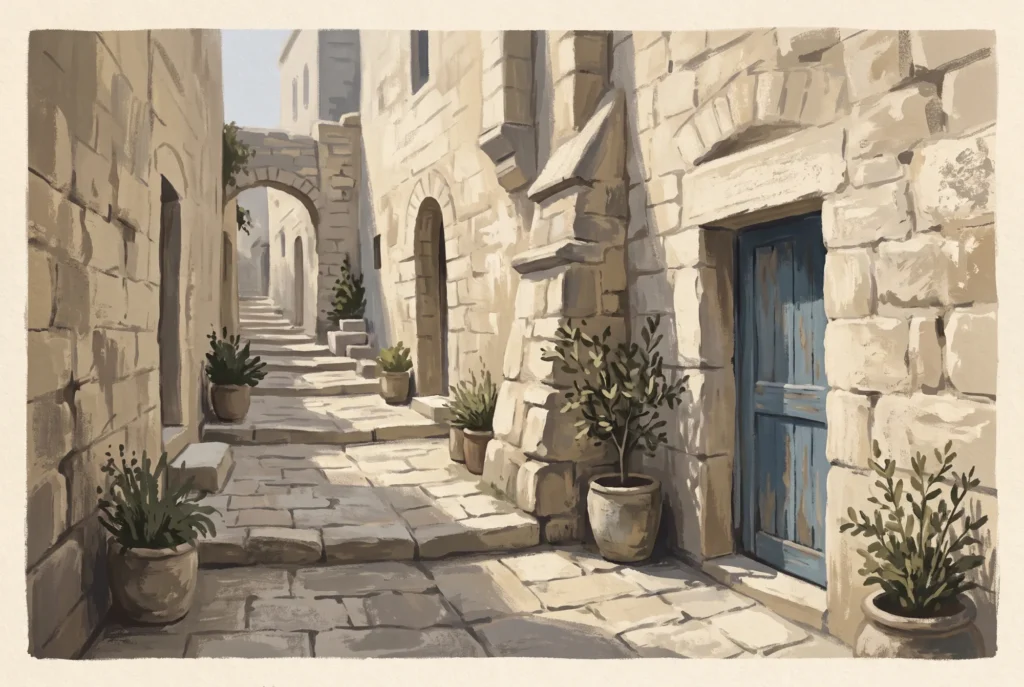
Start by simply walking. The Old City is a maze of vaulted passages, worn staircases and courtyards, and almost every doorframe, grille and window is washed in a particular powdery sky-blue. Locals give two explanations, and both are true in the way that traditions are true: blue is the colour of the sky, so painting a lintel blue “brings heaven down” to a doorway, and blue is held across the region to turn away the evil eye. Neither is a documented rule; both are folk tradition. The tombs of the sixteenth-century sages in the Old Cemetery below are painted the same blue, though that paint dates from a municipal renovation in the early 1990s, not from the sages’ day.
Orient yourself by the long British-built staircase, Ma’alot Olei HaGardom, which cuts the hill in two: the Jewish quarter and its synagogues on one side, the Artists’ Quarter on the other. The Citadel crowns the top; the cemetery spills down the western slope. Everything here is walkable, but steep. Wear real shoes.
The four historic synagogues you can enter
Safed had 32 registered synagogues by 1584. Four historic ones welcome visitors on weekdays (a small donation is welcome). Listings, hours and photos are on our synagogues directory.
Ari Ashkenazi. Built in the late 1500s by Sephardi Jews from Greece and originally called the Gregos synagogue, it was completed a few years after the death of the Arizal, Rabbi Yitzchak Luria, in 1572, and stands on the open field where, by tradition, he walked out with his students on Friday afternoons to greet Shabbat. That field is why congregations worldwide turn toward the door for the last verse of Lecha Dodi. The 1837 earthquake levelled the building; it was rebuilt in 1857. Look for the olive-wood ark carved by a Galician craftsman, crowned with a lion for the Ari’s name, and for the small pockmark on the wooden bimah stand, left when a shell burst in the courtyard in 1948 while the room was packed with people sheltering. Nobody was hurt. Outside, the courtyard is marked as Chakal Tapuchim, the “apple orchard” of the Ari’s Kabbalat Shabbat.
Ari Sephardi. The oldest synagogue in Safed, first recorded in 1522 as the Eliyahu HaNavi synagogue of North African Jews, and sitting low on the hill above the cemetery with Mount Meron in its windows. Tradition says the Ari studied with Elijah the Prophet in the small room off the eastern wall; for generations nobody dared enter it, until the Baba Sali is said to have made it safe again. Notice the three arks on the southern wall, the ancient well beside the bimah, and the holes once cut in the walls for lookouts during the 1948 fighting.
Abuhav. Named for Rabbi Yitzchak Abuhav of fifteenth-century Spain, who never saw Safed. Tradition holds that he designed it in Spain with kabbalistic numbers built into the plan: one bimah, two steps, three arks. The earthquakes of 1759 and 1837 destroyed everything except the southern wall holding those arks. The right-hand ark keeps the oldest Torah scroll in Safed, attributed to Abuhav himself, read only three times a year: Rosh Hashanah, Yom Kippur and Shavuot. Look up into the dome and count the crowns. The Mishnah speaks of four; a fifth, the “crown of redemption”, was added by a town convinced the Mashiach was near.
Yosef Caro. The study hall of the author of the Shulchan Aruch, who arrived in 1536 and led the rabbinical court until his death in 1575 at 87. The room beneath is where tradition says his Maggid, a heavenly teacher, spoke with him. Rebuilt after 1837 with funds from the Italian philanthropist Yitzhak Guetta, who shipped in the Italian stone floor. The glass-fronted cases along the walls are a working genizah of worn holy books, and the ark holds scrolls said to be 200, 300 and 500 years old. Our Yosef Caro synagogue page has the full history.
A fifth, Avritch (Bat Ayin), founded by the Hasidic master Rabbi Avraham Dov of Avritch in the early 1800s and today home to a Sephardi minyan, is worth a stop if its door is open.
The Old Cemetery and the kevarim of the sages
Below the synagogues, thousands of stones tumble down the western slope. Burials stopped in the 1960s, but every day people climb down to the blue-painted kevarim (graves) of the kabbalists who made sixteenth-century Safed the spiritual capital of the Jewish world.
The Arizal lies in the middle under a wide platform, his stone taller than the rest, with an eternal flame behind glass; his son Moshe is beside him, under a tree hung with prayer notes. Just below is the Ramak, Rabbi Moshe Cordovero (1522–1570), author of Pardes Rimonim; tradition says the Ari arrived in Safed on the day of the Ramak’s funeral and was the only mourner to see a pillar of fire over the bier. Nearby are the Radbaz, the Mabit, and Rabbi Shlomo Alkabetz, the Ramak’s brother-in-law and the poet of Lecha Dodi. Follow the path down to a single tree: under it is Rabbi Yosef Karo.
At the foot of the slope is the Ari’s mikveh, fed by a cold spring, where men still immerse before Shabbat as he did (the Ari, his students said, never towelled off, to let Shabbat waters soak in). Women’s and men’s prayer areas are separate throughout. See our kevarim directory, the full Sages of Tzfat index and the hilula calendar for yahrzeit dates, when crowds are largest: 5 Av for the Ari, 13 Nisan for Rabbi Karo.
The Artists’ Quarter and the General Exhibition
Cross the big staircase and the mood changes. In 1949 painters and sculptors moved into the empty houses of the old Arab quarter and founded an artists’ colony; through the 1950s and 1960s it was the liveliest in the young state, with Moshe Castel, Yitzhak Frenkel and Menachem Shemi among its names and more than fifty artists exhibiting at its peak. Today a few dozen galleries line the lanes: micro-calligraphy, kabbalistic abstracts, silver, ceramics and photography, often with the artist at work in the back room.
The General Exhibition, a cooperative showroom for local artists, occupies the former Market Mosque, dated 1901 by the Arabic inscription over its door and now painted pale blue. Our art directory lists galleries and artists you can visit.
The Citadel, the 1837 earthquake and the best views
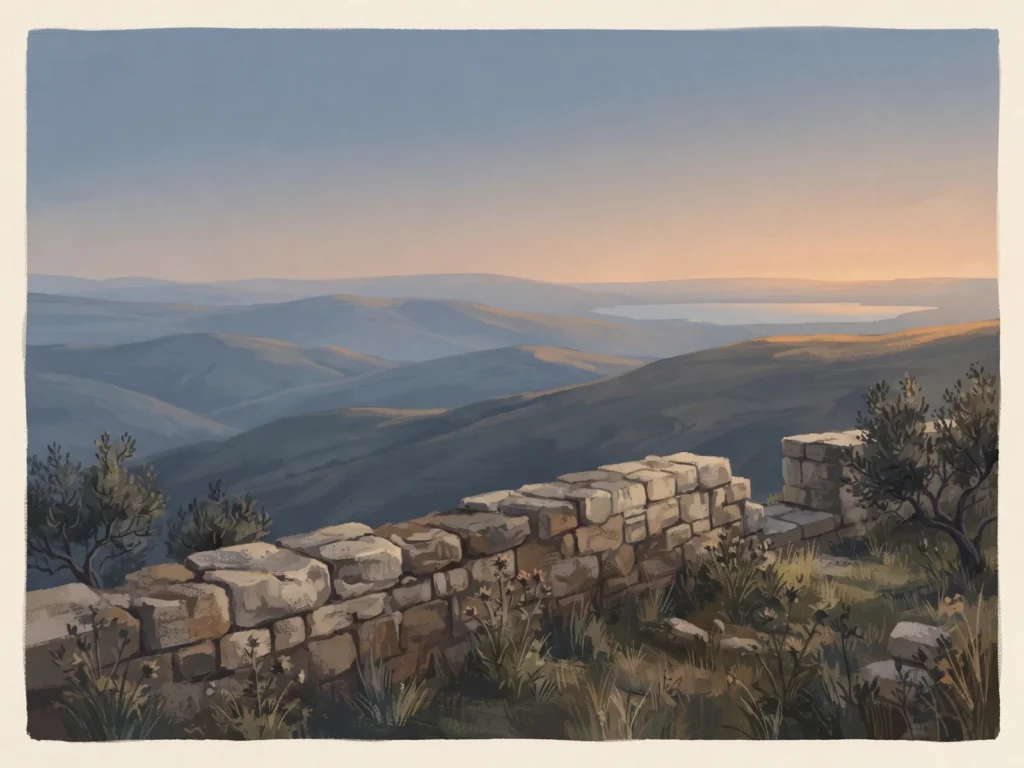
Climb to Gan HaMetzuda, the park on the summit (about 835–846 m; sources differ), for the city’s finest panorama: the Meron massif to the west, the Kinneret (Sea of Galilee) to the south-east, Hermon to the north on a clear winter day. Under your feet are the ruins of one of the largest Crusader castles in the Levant, taken by the Mamluk sultan Baybars after a six-week siege in 1266.
What finished the fortress, and nearly finished the town, was the earthquake of 1 January 1837. Houses on the slope were stacked so that one roof was the street of the next; in the late afternoon, minutes before sunset, they collapsed onto each other, and more than 2,000 people died in Safed, roughly half its Jewish community. Every synagogue in this guide was rebuilt afterwards, which is why so much of “ancient” Safed dates from the 1840s and 1850s. A memorial to the fallen of 1948 stands at the top of the park. See our landmarks directory.
Candles, cheese and the city’s crafts
Two Safed products have become national words. The Safed Candles gallery beside the Ari Ashkenazi synagogue sells hand-braided havdalah candles and shows off wax sculptures that children remember for years. After a fire in 2008, the rebuild uncovered centuries-old rooms now folded into the shop.
Tzfat cheese, the salty white tzfatit you find in every Israeli supermarket, began with the HaMeiri dairy in 1840, founded by a family who came from Persia after the earthquake. Generations later it still makes sheep’s cheese with spring water in the stone house on Keren HaYesod Street above the cemetery; the entrance hall is a small museum, and tastings run on Fridays or by arrangement.
Safed also ran the first Hebrew printing press in West Asia, from 1577; the scribes and micrographers of the Quarter are its heirs.
Meron, Rashbi and the hills around
About 8 km west, Mount Meron holds the kever of Rabbi Shimon bar Yochai, the sage of the Zohar, the most popular Jewish pilgrimage site in Israel. On Lag BaOmer (18 Iyar, his traditional hilula) around 200,000 people come, with a bonfire lit on the roof and three-year-old boys given their first haircuts, a custom that dates from the Ari’s time. A Torah procession has walked from Safed to Meron since 1833. Any other day it is a quiet, powerful place: men’s and women’s sections, modest dress, no fee, and the ruins of a third-century synagogue nearby. Guided tours and drivers can add Amuka, Kadita and the Biriya forest in an afternoon.
Klezmer in August and the rest of the year
Safed’s International Klezmer Festival has run every summer since 1988, three nights of free concerts on stages and street corners across the Old City; the 39th edition ran 18–20 August 2026. Book lodging months ahead. Other dates worth planning around: the sages’ hilulot, Chanukah menorahs in stone windows, and pre-dawn Sephardi selichot in Elul. Current listings are on our events page.
Food, Shabbat and etiquette
Almost every restaurant in the Old City is kosher, which means meat and dairy places are separate and nearly everything closes from Friday afternoon until Saturday night. Plan your eating around that: a Friday lunch of local cheese, a Yemenite lachuch or a Shabbat meal booked in advance through your hotel. See restaurants and places to stay. Shabbat here is not a problem to manage but a reason to come: by late Friday the lanes go silent and the singing from a dozen synagogues carries in the stone.
Etiquette is simple. Dress modestly at synagogues and kevarim (shoulders and knees covered; many women bring a skirt and scarf). Men cover their heads inside; kippot are usually at the door. Do not photograph people at prayer, and put the camera away entirely on Shabbat and holidays in the Old City. Keep to the men’s or women’s side at graves, speak softly, and if a service is underway, wait at the back.
Best season, how long to stay, and two plans
Safed sits around 900 m up, so it is cooler than the rest of Israel: spring and autumn are perfect, summer evenings are pleasant, winters bring fog, rain and occasional snow on the blue doors (beautiful, slippery). A day is enough for the Old City; two nights let you breathe.
One day: Citadel park for the view, down through the Jewish quarter to Yosef Caro and Abuhav, the candle gallery and Ari Ashkenazi, lunch, Ari Sephardi, the cemetery and the Ari’s kever, then up the great staircase into the Artists’ Quarter for the late afternoon.
Two days: Day one as above. Day two: Meron in the morning, HaMeiri dairy and museum at midday, a mikveh or a class on where to learn Kabbalah in Tzfat, then sunset from the Citadel. Our free audio tours narrate the synagogues as you walk; the gallery shows what to look for. Safed is the smallest of the Four Holy Cities and, for most visitors, the one that lingers.
Keep reading
Frequently asked questions
Is Safed worth visiting? Yes, especially if you care about Jewish history, art or simply atmospheric old towns. It is compact, walkable and unlike anywhere else in Israel, and a single day gives you its synagogues, cemetery and galleries. Pair it with the Galilee or the Golan.
How many days do you need in Tzfat? One full day covers the Old City. Two days (one night, ideally Friday) adds Meron, the HaMeiri dairy and Shabbat. Avoid arriving on a Saturday, when nearly everything is closed.
What is the best time to visit Safed? April–June and September–November for mild weather. August for the Klezmer Festival, Lag BaOmer (May) for Meron, but expect crowds. Winter is cold, atmospheric and occasionally snowy.
Can tourists enter the synagogues in Safed? Yes. The Ari Ashkenazi, Ari Sephardi, Abuhav and Yosef Caro synagogues are open to visitors on weekdays; hours vary by synagogue and season, and a small donation is welcome. Dress modestly and men should cover their heads.
Why is Safed painted blue? Local tradition gives two reasons: blue is the colour of heaven, and it wards off the evil eye. Neither is documented. The blue on the kabbalists’ tombs in the Old Cemetery is more recent still: the municipality painted them in the early 1990s.
How do I get to Safed without a car? Direct buses run from Jerusalem (Nateev Express line 982, about 3 hours, a few departures a day) and Tel Aviv (Egged line 846, one afternoon departure a day); from Haifa, Akko and Karmiel railway station there are more frequent connections. Check Moovit for current timetables, and remember buses stop on Friday afternoon.
Sources
- Ari Ashkenazi Synagogue – Wikipedia — Greek founders, 1837 destruction, olive-wood ark, 1948 shrapnel
- Ari Ashkenazi Synagogue – Zissil — “Gerigos”/Gregos name, pockmark on the bimah, Chakal Tapuchim courtyard
- Avritch (Bat Ayin) Synagogue – Zissil — founded by Rabbi Avraham Dov of Avritch; Sephardi customs today
- The HaAri Synagogues – Jewish Virtual Library — Ari Sephardi history, Elijah’s room, the well, 1857 rebuilding, bonfire column
- The Abuhav Synagogue – Jewish Virtual Library — one-two-three design, surviving south wall, scroll read three times a year, five crowns
- Historical Sites of Safed – Jewish Virtual Library — Yosef Caro synagogue, cemetery, Ari mikveh, Artists’ Quarter, General Exhibition
- Yosef Caro Synagogue – Zissil — Guetta rebuilding, Italian floor, genizah cases, scroll ages
- Tzfat Cemetery – rashbi.org — locations of the sages’ kevarim, customs, blue tombs
- 1837 Galilee earthquake – Wikipedia — date, stacked houses, casualties
- Citadel of Safed – Wikipedia — Crusader and Mamluk history, elevation, park and views
- Safed – Wikipedia — elevation, climate, 1577 press, 1584 synagogue count, Artists’ colony
- Moses ben Jacob Cordovero – Wikipedia — dates, Pardes Rimonim, pillar of fire
- Solomon Alkabetz – Wikipedia — dates, Cordovero relationship, Lecha Dodi
- HaMeiri Dairy – Zissil — 1840 founding, family from Persia after the earthquake, spring water, Friday tours, museum hall
- Safed Cemetery – Atlas Obscura — early-1990s municipal painting of selected graves blue
- Safed Candles – Zissil — location, 2008 fire, hand-woven havdalah candles
- Hillula of Rabbi Shimon bar Yochai – Wikipedia — attendance (~200,000), haircuts from the Ari’s time, Safed Torah procession since 1833, most popular pilgrimage site
- Side trips from Safed – Frommer’s — Meron 8 km west, third-century synagogue ruins
- International Klezmer Festival in Safed – Wikipedia — founded 1988, free
- 39th Klezmer Festival – BroadwayWorld — 18–20 August 2026 dates
- Jewish center of mysticism – Times of Israel/AP — blue doors and heaven
- Moovit line 982 and Moovit line 846 — Jerusalem (Nateev Express) and Tel Aviv (Egged, once daily) lines, durations