
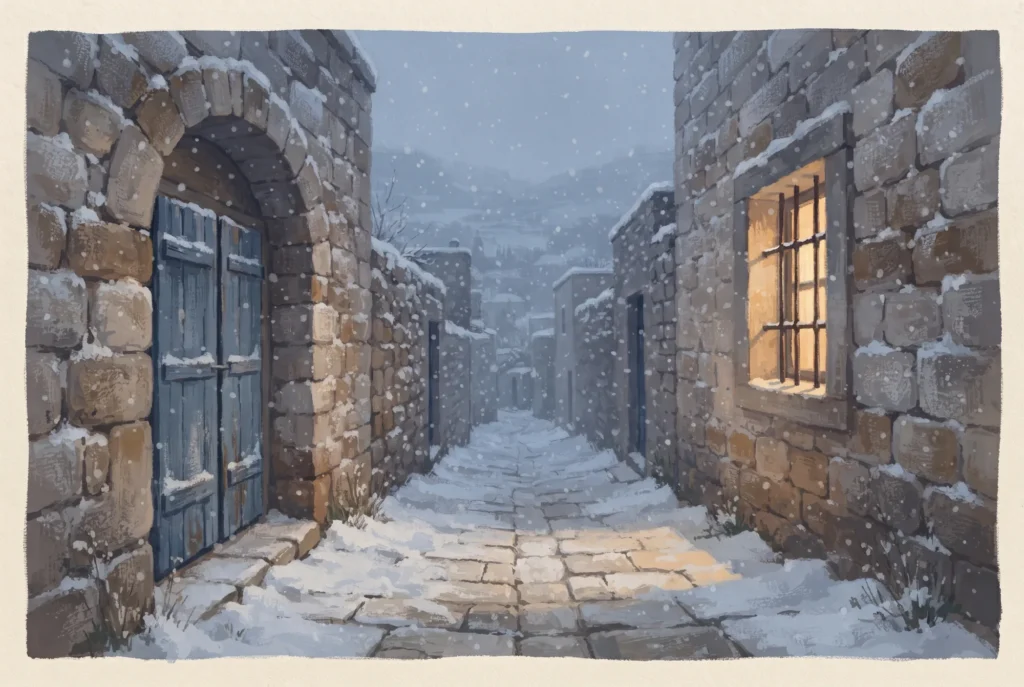
Yes, it snows in Tzfat (Safed), though not every year and rarely for long. At 800 to 937 m it is the highest city in Israel and usually the coldest, with January days around 10°C, nights near 5°C and frost on the stone. Between December and February the Old City belongs to the people who live in it, and if you come prepared for wet steps and a cold wind, this is the most intimate season to be here.
The numbers: Safed’s winter month by month
The Israel Meteorological Service station on Mount Canaan (Har Kenaan), just above the city, gives these averages for 2004 to 2022, as reproduced in the Wikipedia climate table for Safed:
| Month | Avg high | Avg low | Rain (mm) | Rainy days |
|---|---|---|---|---|
| November | 18.1°C | 11.4°C | 72 | 8 |
| December | 12.6°C | 7.3°C | 143 | 11 |
| January | 10.3°C | 5.0°C | 182 | 14 |
| February | 12.2°C | 6.0°C | 123 | 11 |
| March | 15.6°C | 7.9°C | 61 | 10 |
Nearly 450 mm of the city’s roughly 680 mm annual rainfall arrives in those three core winter months, and the Wikipedia article notes that night frost is common and that precipitation falls occasionally as snow. Frommer’s puts it plainly: Safed in winter is windy and can be as much as 20 degrees (Fahrenheit) cooler than Tiberias, 30 to 40 minutes down the hill. Ashkenazi speakers say “Tzfas”; older maps and road signs write “Zefat” or “Tsfat”. Whichever you type, the forecast is the same.
Does it snow in Safed, and how often?
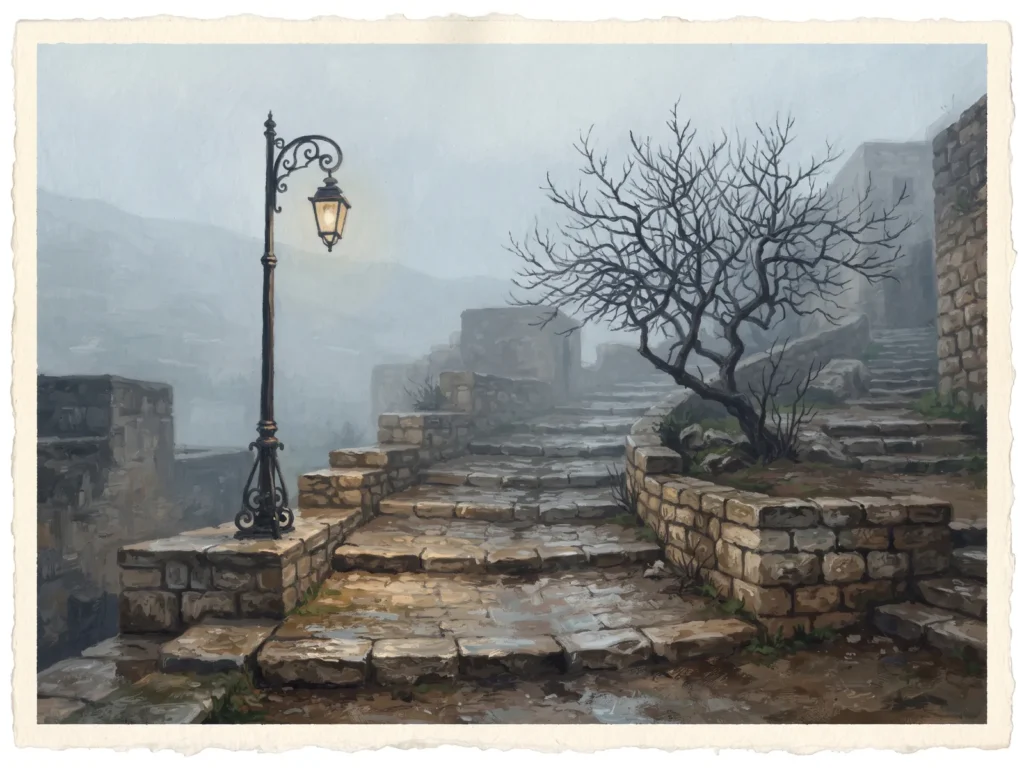
Going by news coverage of the last fifteen years (there is no published snow-day statistic for the city), snow that actually settles comes roughly every second or third winter, usually in January or February, and typically lasts a day or two before rain washes it away. Big accumulations are rare: the record most often cited is the February 1950 storm, when about 60 cm fell on the city.
Recent confirmed snow years, from news coverage:
- December 2013 (Storm Alexa): over a thousand Safed households lost power and schools were closed from Sunday 15 December through at least Tuesday 17 December.
- January 2015: streets were white by morning on 7 January; police closed the mountain roads in and out of the city and halted public transport, and schools closed as temperatures kept falling.
- January 2016: light snow on Mount Canaan and the upper neighbourhoods; the municipality cancelled school for the day.
- February 2021: snow on 17 February, with some schools closed, snowploughs readied, blankets distributed and residents warned of power cuts.
- January 2022 (Storm Elpis): snow on 19 January and again on 26 to 27 January, when forecasts called for 10 to 20 cm; the city opened its emergency headquarters, sent pupils home at noon, and the mayor asked residents to finish their errands and be home before the snow.
Snow has even fallen out of season: on a Friday in April 2015 flakes came down over the city, too briefly to stick.
What happens when it snows
Safed’s roads are steep, narrow and shaded, so even a few centimetres bring the city to a standstill. In a real storm the police shut the approach roads, including the main climb up from Rosh Pina, and buses stop running. The municipality convenes an emergency centre, salts the main routes (the roads to Ziv Hospital among the first), keeps ploughs on standby and decides each morning whether schools open, close or send children home at midday for remote learning. Power cuts happen.
For a visitor the rule is simple. If snow is forecast, arrive the day before or wait a day after; do not try to drive up during the storm. Once the roads reopen, the Old City in snow is extraordinary: white domes above blue doorways, children sledging on the Citadel slopes, the Ari Ashkenazi roofline against a grey sky. See the gallery.
Fog, wind and rain on stone
More days than snow, you will meet cloud. Safed sits at the height where Galilee weather fronts drag their bellies, so the Old City can vanish into fog for an hour, then open to a rinsed view of the Kinneret 1,100 m below. Westerly winds funnel through the alleys, and the limestone steps are slick when wet; the polished stairs below the Ari Ashkenazi and around the Yosef Caro Synagogue are the places people slip.
After rain, this is the clearest air of the year: from the Citadel you may see Mount Hermon white in the north, a view the summer haze never gives.
What is open in winter
Synagogues keep their daily prayer times whatever the weather, and most of the historic synagogues admit visitors between services as usual. The kevarim in the Old Cemetery are always open, though the steps down are treacherous in rain.
The Artists’ Quarter is a different matter. Many galleries are run by the artists themselves and in the quiet months some open only at midday, on request, or on days the forecast is kind; it is worth phoning ahead or checking a listing before you make the walk. Restaurants and cafés mostly stay open, and a bowl of soup in a stone-vaulted room with the rain outside is half the point of coming.
Why winter is beautiful here
In summer the alleys fill with day-trippers; in January you can stand alone in the Alkabetz courtyard and hear nothing but rain in the gutters. Wood smoke hangs over the Old City in the evenings, because many of the old houses still heat with stoves. Shabbat comes in early, before 4:30 pm in December, and the lamps in the synagogue windows show against a dark sky by the time Lecha Dodi is sung, the hymn composed in this town.
Chanukah (4 to 12 December 2026) is the season’s festival. Families in the Old City light their menorahs in glass boxes at the doorway or in the window facing the lane, in the old Jerusalem and Safed manner, so a walk after dark passes dozens of flames at knee height. Public lightings and children’s events are organised each year by Chabad and community groups; check events for the current programme.
Winter hilulot
The quiet season has its own pilgrimage dates, drawn from our verified hilula calendar:
- 12 Kislev (22 November 2026): the Bat Ayin, Rabbi Avraham Dov of Avritch, who rebuilt Safed after the 1837 earthquake; his kever is in a cave below the Ari, and the Avritch Synagogue holds the celebration.
- 27 Kislev (7 December 2026, during Chanukah): the Be’er Mayim Chaim, Rabbi Chaim of Chernovitz, buried in a cave left of Rabbi Yosef Karo.
- 20 Tevet (30 December 2026): the Rambam, whose tomb in Tiberias, 30 to 40 minutes away, is honoured by a tradition recorded since the thirteenth century.
- 4 Shevat (12 January 2027): Rabbi Avraham of Kalisk, also in Tiberias, among the Chassidic leaders who first settled in Safed in 1777.
Tu BiShvat and the almond blossom
Tu BiShvat, the New Year for Trees, falls on 22 to 23 January 2027 (a Shabbat). Almond trees are the first to flower in Israel, and the timing swings with the winter: tradition pairs the blossom with Tu BiShvat, a warm winter brings it out in early February, and a cold, late one holds it back to March. The Galilee hills around Safed bloom later than the lowlands because of the altitude, so the white and pink blossom on the slopes towards Meron and Kadita is usually a February sight.
Practical advice for a winter visit
- Layers and a real shell. Wind is the issue more than temperature; a waterproof over a fleece beats a heavy coat.
- Shoes with grip. Wet limestone steps are the main hazard of the Old City. Leave the smooth soles at home.
- Ask your host about heating. Old stone houses are cold; some guesthouses have central heating, others a single unit or a wood stove. Ask before booking from our accommodations list, and ask whether Shabbat heating is set on a timer.
- Watch the forecast for snow. Arrive before or after, not during; see getting to Tzfat for the roads.
- Daylight is short. Do the Old Cemetery and the landmarks at midday; keep indoor things to do for after 4 pm.
Frequently asked questions
Does it snow in Safed? Yes. Safed is the highest city in Israel and snow settles roughly every second or third winter, usually in January or February. Confirmed recent snowfalls include December 2013, January 2015, February 2021 and January 2022. It rarely lasts more than a day or two.
What is the weather in Safed in December and January? December averages 12.6°C by day and 7.3°C at night with about 143 mm of rain; January is the coldest and wettest month at 10.3°C and 5.0°C with about 182 mm on 14 rainy days. Frost at night is common and the wind makes it feel colder.
What happens to the roads when it snows in Safed? Police close the steep approach roads, including the climb from Rosh Pina, and buses stop. The municipality salts the main routes, the hospital roads among the first. Roads usually reopen soon after the snow stops.
Are the galleries open in winter? Most synagogues, kevarim and restaurants keep normal hours. Many artist-run galleries reduce their hours in the quiet months or open on request, so phone ahead or check listings before walking down.
When do the almond trees blossom near Safed? Traditionally around Tu BiShvat (22 to 23 January 2027), but in practice anywhere from early February after a warm winter to March after a cold one. The hills around Safed bloom later than the valleys, so February is the safer bet for the slopes towards Meron.
Sources
- Wikipedia, Safed (climate table) — IMS Har Kenaan station averages 2004 to 2022; elevation; frost and occasional snow.
- Wikipedia, Snow in Israel — 60 cm in Safed, 6 to 7 February 1950; snow uncommon nationally, confined to high ground.
- Times of Israel, 14 Dec 2013 — Storm Alexa: 1,000+ Safed households without power; schools to close Sunday 15 December.
- Jerusalem Post, 16 Dec 2013 — Safed schools still shut on 17 December.
- Times of Israel liveblog, 7 Jan 2015 — Safed streets snow-covered; mountain roads in and out closed by police; public transport halted; roads not named.
- Jerusalem Post, 9 Jan 2015 — school cancellation in Safed (headline only survives on the page).
- Jewish Press, 24 April 2015 — out-of-season Friday-morning flurries, not enough to stick.
- Israel Hayom (Hebrew), 1 Jan 2016 — light snow on Mount Canaan; municipality cancels school.
- Times of Israel, 17 Feb 2021 — snow in Safed, some schools closed, ploughs readied, blankets distributed, power-cut warning.
- Times of Israel, 20 Jan 2022 — photo captions of snow in Safed dated 19 January 2022.
- Mako (Hebrew), 25 to 26 Jan 2022 — Elpis: 10 to 20 cm forecast for Safed; emergency HQ; schools to noon; Mayor Shuki Ohana asks residents to be home by Wednesday afternoon.
- Maariv (Hebrew), municipality snow readiness (undated) — 25 tonnes of salt, roads to Ziv Hospital among the routes to be salted, ploughs on standby.
- Frommer’s, Planning a trip to Safed — winter wind; “as much as 20°” cooler than Tiberias (no drive time given; 30 to 40 minutes is from our getting-to-Tzfat page).
- Hebcal, Jewish holidays 2026 to 2027 — Chanukah 4 to 12 December 2026; Tu BiShvat 22 to 23 January 2027.
- Jerusalem Post video, Late winter delays almond blossom — almond trees “usually blossom around Tu Bishvat”; a late winter pushed bloom to early March. Hayadan, 16 Feb 2025 — bloom expected towards the end of winter, around March; a warm winter brought it forward to early February.
- Site file 10-hilulot-kevarim-calendar.md (YAHRZEITS-VERIFIED) — 12 Kislev, 27 Kislev, 20 Tevet, 4 Shevat dates and Gregorian equivalents (re-run through the Hebcal converter API on 17 Nov 2026: 22 Nov 2026, 7 Dec 2026, 30 Dec 2026, 12 Jan 2027).