In May 1948, a few weeks before the State of Israel was declared, a small Jewish quarter in Tzfat (Safed) was besieged inside a largely Arab town, and a Palmach battalion fought its way up the hill to relieve it. The battle ended on 10–11 May with the Citadel, the police fort and the town in Jewish hands and the Arab population gone. This page tells the story as historians reconstruct it, separates it from the legend of the Davidka, and walks you to the places where it happened, which are all within fifteen minutes of each other.
A town of 12,000, a quarter of 1,500
Safed on the eve of the war was, in Benny Morris’s figures, a town of roughly 10,000–12,000 Arabs and about 1,500 Jews. The British Survey of Palestine put the end-1946 population at 12,610, of whom 2,400 were Jewish, so the Jewish figure depends on who is counted and when; local accounts often say “about 1,700, mostly elderly and religious”. Either way, the proportions are not in doubt: the Jewish community was a small, old and overwhelmingly observant minority, living in the quarter that is today’s Old City around the synagogues of the Arizal and Rabbi Yosef Karo.
Ashkenazi speakers say “Tzfas”; older maps write “Zefat” or “Tsfat”; Arabic sources say Safad.
Memories of 1929 hung over the town: in the riots of that year some eighteen to twenty Jews had been murdered in Safed and houses burned, among them the building that is now the Beit HaMeiri museum. From December 1947 the quarter was effectively under siege, supplies came in by convoy or by mule, and the Haganah defence was commanded locally by Meir Meivar.
The British leave, and the high ground changes hands
The British evacuated Safed on 15–16 April 1948, a month earlier than the Jewish community had expected. As they left they handed the town’s commanding positions to Arab forces: the Citadel (Metzuda) on the summit, the Tegart-style police fort at the top of the stairs on Jerusalem Street, the police post on Mount Canaan, and Beit Shalva, a large house at the entrance to the town.
Morris counts 700–800 local and foreign irregulars in Safed. Israeli accounts add that they were reinforced by a Syrian battalion of the Arab Liberation Army under Adib Shishakli, later president of Syria, and that Iraqi fighters held the police station.
The Palmach arrives over Mount Canaan
On the night the British left, about thirty-five Palmach fighters under Elad Peled came down from the Mount Canaan side into the Jewish quarter. They were the advance guard of the Palmach’s Third Battalion, commanded by Moshe Kelman, which assembled on Mount Canaan as part of Operation Yiftach, Yigal Allon’s campaign to secure the eastern Galilee before the Mandate ended on 14 May. The brigade that grew out of the operation took the name Yiftach, which is why the road up to the Citadel is Hativat Yiftach Street.
On 28 April the Haganah took the Rosh Pina police fortress, and the Palmach moved on Biriya and Ein Zeitun, the village just north of the town, opening a supply corridor into the quarter. The attack on Ein Zeitun on 1 May opened with a Davidka among the mortars. It was also the scene of the war’s darker side: Morris records that 37 prisoners taken there were probably among some 70 men executed in a valley near Safed two days later, an episode written about in Israel for decades. A further Palmach force entered the quarter on 3 May.
6 May: the first attack fails
On the night of 6 May the battalion tried to storm the Citadel. A fortified machine-gun post below the summit stopped the assault; seven fighters were killed, and Ze’ev Cohen, a Safed scout who had guided the attackers, was wounded and left behind, his body found only after the town fell. The Arabs had meanwhile brought in reinforcements and artillery. Allon then brought a PIAT, a British anti-tank weapon, up to Safed to deal with the machine-gun nest.
9–10 May: the Davidka, the rain and the night of fighting
The second attack opened on the evening of 9 May with a concentrated mortar bombardment, including the Davidka. Then, in heavy and unseasonal rain, four assault groups went for four targets at once: the Citadel, the police fort, Beit Shalva and the Mount Canaan police post. A Holocaust survivor named Michael Push, who had served with the Jewish Brigade, silenced the machine-gun post with the PIAT; the Citadel fell. The hardest and longest fight was at the police station, where a Palmach company commander, Yitzhak Hochman, was killed. Beit Shalva was taken the same night. By morning on 10 May the strongpoints were in Jewish hands, and by 11 May the Arab quarters were found empty.
The Davidka itself was a homemade 3-inch mortar designed by David Leibowitch at the Mikveh Israel school; only six were made, two per Palmach brigade. Its oversized shell was unstable in flight and wildly inaccurate, and historians doubt it did much damage. What it had was noise.
The legend, and what historians say
The story every guide in Safed tells goes like this: the Davidka’s unearthly roar, followed by the sudden rainstorm, convinced the Arab population that the Jews had an atomic bomb (everyone knew rain followed Hiroshima), and the whole town fled overnight. Some versions add that the Haganah deliberately spread the rumour, or that Jewish residents passed it to Arab neighbours. For many in Safed the episode was, and is, a miracle.
Historians are more cautious. The military histories record a heavy mortar barrage, rain and a night of house-to-house fighting, with the strongpoints in Jewish hands by morning; the bomb rumour belongs to memoir and folklore. Morris attributes the collapse to the fall of the dominating positions after the bombardment and to the Transjordanian volunteer unit being ordered out of the town that same night after quarrels among the Arab leadership; the destruction of Ein Zeitun a week earlier and months of fear across Arab Palestine are also cited. Most of Safed’s roughly 10,000 Arab residents left on 10–11 May; about 100 elderly Muslims and some 35 elderly Christians remained, and were removed to Lebanon and to Haifa in late May and June. The family of Mahmoud Abbas, later president of the Palestinian Authority, was among those who left. The former Arab quarter became the Artists’ Quarter of the 1950s. 10 May 1948 was 1 Iyar 5708, and Safed marks its liberation day each year in Iyar.
Ma’alot Olei HaGardom: the stairs that divided the city
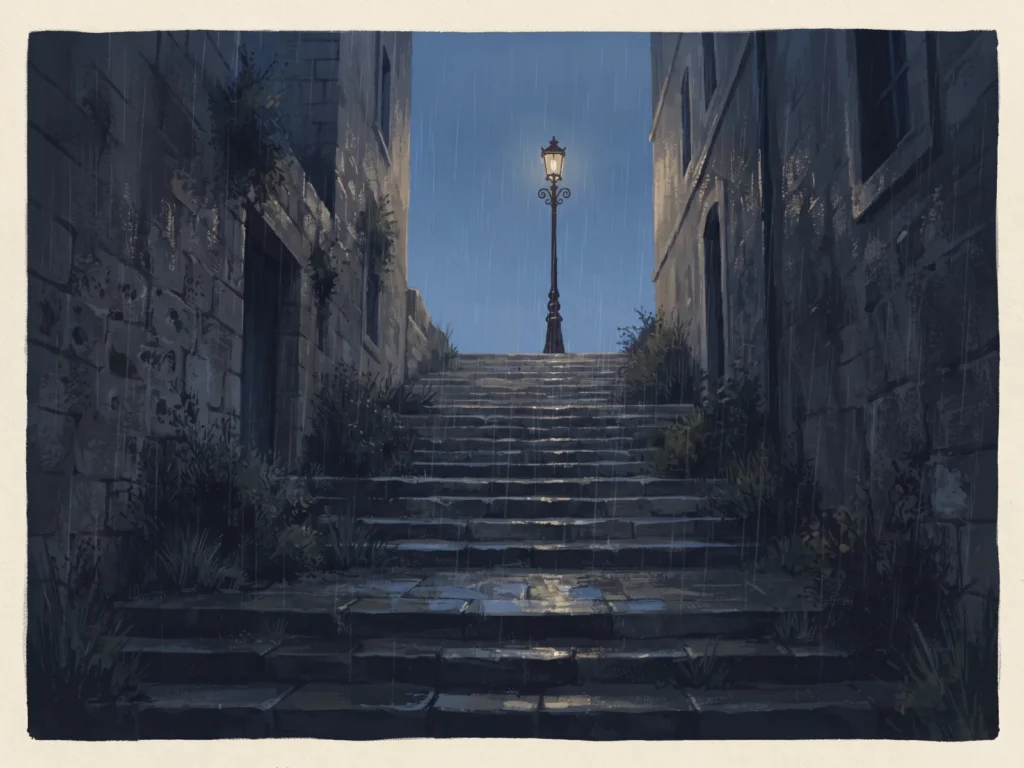
The long, straight stairway that drops from Jerusalem Street to Keren HaYesod Street was cut by the British Mandate authorities in the late 1930s, after the riots of 1929 and in the years of the Arab Revolt of 1936–39, as a physical buffer between the Jewish and Arab quarters. Some small houses were demolished to make it. A British gun position above the post office commanded it, and a searchlight lit it at night; the searchlight is still in place at the top.
In 1948 the stairs were the front line, grimly nicknamed the “Stalingrad line” by the defenders. After the war the city renamed them Ma’alot Olei HaGardom, “the steps of those who went up to the gallows”, for the Irgun fighters hanged by the British at Acre prison in 1947. Seven of them, Dov Gruner, Yehiel Dresner, Mordechai Alkahi and Eliezer Kashani (hanged 16 April 1947) and Avshalom Haviv, Meir Nakar and Yaakov Weiss (29 July 1947), are buried together at the edge of Safed’s old cemetery, a short walk from the kevarim of the Arizal and Rabbi Yosef Karo. There are more than 300 steps, and the stairway now runs through the middle of the tourist bus park.
The Davidka monument and the old police station
At the top of the stairs, where Jerusalem Street widens into the pedestrian Midrahov, stands the Davidka itself on a stone plinth, installed on 29 April 1956 in Leibowitch’s presence. A wreath is laid there each Yom HaZikaron. Opposite it is the British police station of 1948, now part of Safed Academic College; its facade and the concrete pillbox jutting into the road are still pocked with bullet holes, and the pillbox has been left standing for its historical value. A plaque on the pillbox tells the story, and an audio post plays it in Hebrew and English.
Two smaller sites complete the picture. Beit Eshtam, the old commercial building at the entrance to the Old City near the bus park, was a forward outpost and arms store; in 2020 workers found a tunnel beneath it, dug in 1948 by Arab fighters to blow it up and abandoned when they believed it had been discovered, part of its roof later brought down by winter rains. And a plaque at the entrance to Beit Bosel remembers Avraham Shachror, shot by a sniper on 2 January 1948 while bringing supplies in by mule.
The Citadel (Metzuda) park today
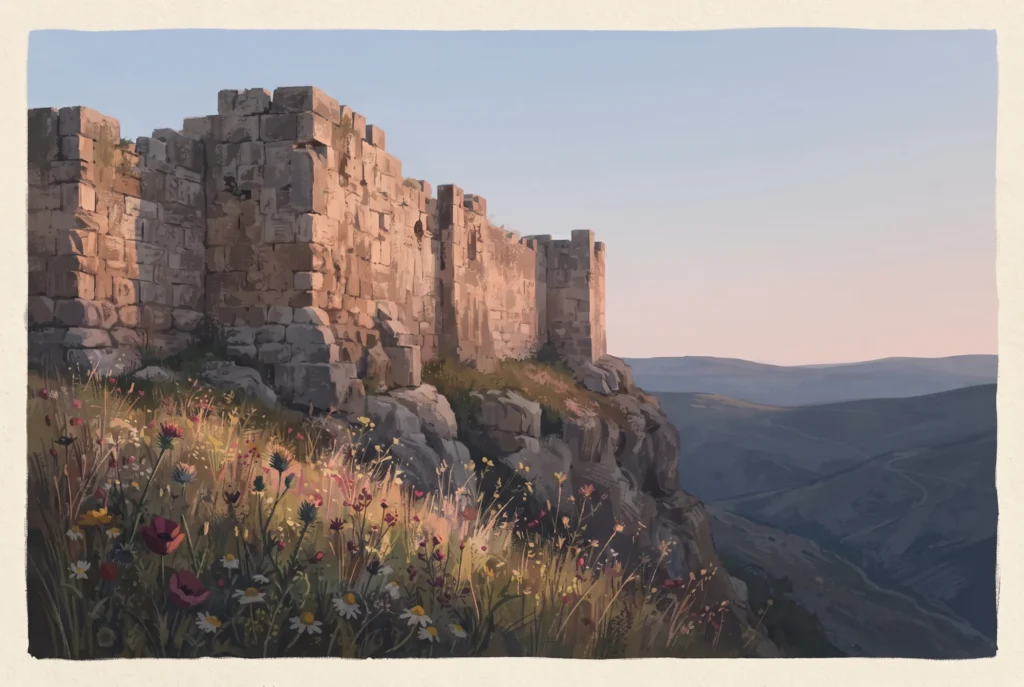
Climb Hativat Yiftach Street or the lane beside the bus stop on Palmach Street and you are on the summit, about 835–846 metres up (sources differ), the highest point of the city. The Crusaders fortified it in 1102 and 1140; the Knights Templar held it from 1168 until Saladin’s forces took it after a long siege in 1188; the Crusaders rebuilt it from 1240 into one of the largest castles in the Levant; and the Mamluk sultan Baybars captured it after a six-week siege in July 1266, then added a huge round tower. Qaitbay restored it in 1475, Ali, son of Daher el-Omar, refortified it in the 18th century, and the earthquake of 1837 brought most of what was left down.
Excavations have exposed a Gothic vaulted hall, arrow-slit walls, the base of Baybars’s tower and a plastered well. The outer moat is the dip that Jerusalem Street crosses. The garden was laid out in 1950 by landscape architect Shlomo Oren Weinberg; at the top stand the War of Independence monument and a memorial naming the fourteen fighters who fell taking the Metzuda. The park is free to enter; the view runs from Mount Meron to the Kinneret and, on a clear day, the Golan.
Beit HaMeiri: the history rooms
The HaMeiri museum, at the corner of Keren HaYesod and Kiryat Breslev below the Old City, is the place to see 1948 from inside the besieged quarter. The building, with 16th-century rooms at street level and two 150-year-old vaulted halls that once housed the Sephardi rabbinical court, was burned in 1929 and then used as a secret arms store and guard post. Its “Heroic Safed” room was a firing position: the windows are sealed and the loopholes cut in 1948 are still in the walls. Upstairs a balcony used by the defenders overlooks the former Arab quarter. Hours are roughly 9:30–14:30, Fridays to 12:00; check before you go. Yehezkel HaMeiri, a fifth-generation Safed native, spent thirty years restoring the house.
A walking route of the 1948 sites (about 2 hours)
- Davidka monument and old police station, top of the Midrahov on Jerusalem Street (20 min). Read the plaque, find the bullet holes, look at the pillbox.
- Citadel park: up Hativat Yiftach Street to the summit (15 min climb, 30 min on top). Memorial, Crusader hall, view.
- Back down to Jerusalem Street and the British gun position and searchlight at the head of the stairs (5 min).
- Ma’alot Olei HaGardom: descend all the way to Keren HaYesod Street (15 min), noticing the Old City on one side and the Artists’ Quarter on the other.
- Beit Eshtam and the bus-park entrance to the Old City (10 min).
- Beit HaMeiri (45 min). Finish with lunch at one of the Old City restaurants, or continue down to the old cemetery and the graves of the Olei HaGardom (add 30 min).
The ground is steep and stepped; wear real shoes. Several tour guides listed on this site offer guided versions, and the audio tours of the Old City pass most of these points. See also Safed’s other landmarks, the Artists’ Quarter galleries in the former Arab quarter, and, for the city’s earlier history, the sages of Tzfat.
Recommended reading
- Benny Morris, 1948: A History of the First Arab-Israeli War (2008), pp. 102–105 for Safed, and The Birth of the Palestinian Refugee Problem Revisited (2004).
- Chaim Herzog and Shlomo Gazit, The Arab-Israeli Wars (rev. 2005), the standard Israeli military narrative.
- Netiva Ben-Yehuda, 1948 – Between Calendars (Hebrew), a Palmach fighter’s memoir of the Galilee campaign.
- Meir Meivar, In the Shadow of the Citadel (Hebrew), the Haganah commander’s memoir of the defence of Safed, and the Safed Liberation Day booklet.
- Walid Khalidi, All That Remains (1992), for the Arab villages around Safed.
Keep reading
Frequently asked questions
When was the battle of Safed in 1948? The British left on 15–16 April 1948. A first Palmach attack on the Citadel on the night of 6 May failed; the decisive assault was on the night of 9–10 May, and the town was fully in Jewish hands by 11 May, three days before the end of the Mandate. 10 May 1948 fell on 1 Iyar 5708, and the city marks its liberation day in Iyar.
What is the Davidka and did it really win the battle? The Davidka was a crude homemade mortar, named for its designer David Leibowitch, that fired a heavy, unstable shell with a tremendous noise. Only six were built. Its bombardment preceded the final assault, and local tradition credits its roar, plus a freak rainstorm, with panicking the town. Historians treat that as a legend layered on a real military collapse.
Who were the Olei HaGardom the stairs are named for? The Irgun members hanged by the British at Acre prison in 1947: Dov Gruner, Yehiel Dresner, Mordechai Alkahi, Eliezer Kashani, Avshalom Haviv, Meir Nakar and Yaakov Weiss. All seven are buried in Safed’s old cemetery, and the British-built stairway dividing the two quarters was renamed in their memory after the war.
Can you visit the Safed Citadel? Yes. The Metzuda park on the summit is free to enter, reached from Hativat Yiftach Street or by steps from Jerusalem Street. You will find excavated Crusader and Mamluk remains, the 1948 memorials and the best panoramic view in the city.
Where can I see bullet holes from 1948 in Safed? On the old British police station and its pillbox opposite the Davidka monument on Jerusalem Street, on Beit Eshtam at the Old City entrance, and inside Beit HaMeiri, where the loopholes of the 1948 firing position are still cut in the museum walls.
Sources
- Operation Yiftach – Wikipedia — population figures, 6 and 9–10 May attacks, Morris and Herzog citations, remaining civilians.
- Battle of Safed – Wikipedia (mirror) — Survey of Palestine table, Arab forces, Transjordanian unit withdrawn.
- Operation “Yiftach” – Jewish Virtual Library — British withdrawal, positions handed to Arabs, Rosh Pina, rain/atomic rumour as popular story.
- The Safed City Police Station – Jewish Virtual Library — handover on 16 April, 10 May battle, Hochman, pillbox, plaques, Safed Academic College.
- Safed Liberation Day booklet (Hebrew, PDF) — Elad Peled’s 35 fighters, four targets, PIAT, seven fallen on 6 May, Ze’ev Cohen, Shachror’s mule, Beit Eshtam.
- Uri Milstein in Maariv (Hebrew) — Kelman, Dov Zeira, Michael Push and the PIAT, Ein Zeitun prisoners.
- Moshe Kelman – Wikipedia (mirror) — Third Battalion command, Ein Zeitun.
- Davidka – Wikipedia (mirror) — design, six made, inaccuracy, atomic anecdote framed as story.
- Davidka of Safed – Zissil — the popular version of the rain/atom-bomb story, Beit Shalva, police station.
- The Davidka Monument – safed.co.il — 1956 installation, Leibowitch, audio post, pillbox.
- Safed – The Key to the North in 1948 – safed.co.il — “about 1,700, mostly elderly and religious”, 9–11 May chronology, Abbas family.
- Citadel of Safed – Wikipedia — Crusader, Templar, Baybars, Qaitbay, 1837, excavated remains, 1950 garden by Weinberg.
- The Citadel Park – safed.co.il — 834 m, memorial with 14 names, access routes.
- Great Stairs / Olei HaGardom – ESRA Magazine — late-1930s construction, searchlight, “Stalingrad line”, seven Etzel fighters buried in Safed.
- Maalot HaGardom – Zissil — British sentries and spotlights, 300+ steps, renaming after the war.
- Ynet on the Safed old cemetery (Hebrew) — seven of the twelve Olei HaGardom buried there.
- Dov Gruner – Wikipedia (mirror) — burial at the Old Jewish Cemetery, Safed; execution 16 April 1947.
- 1948 tunnel unearthed in Safed – Israel Hayom — Beit Eshtam tunnel, Geiger and Meivar.
- Beit HaMeiri – safed.co.il and HaMeiri Museum – Zissil — building history, 1929, Heroic Safed room, hours.