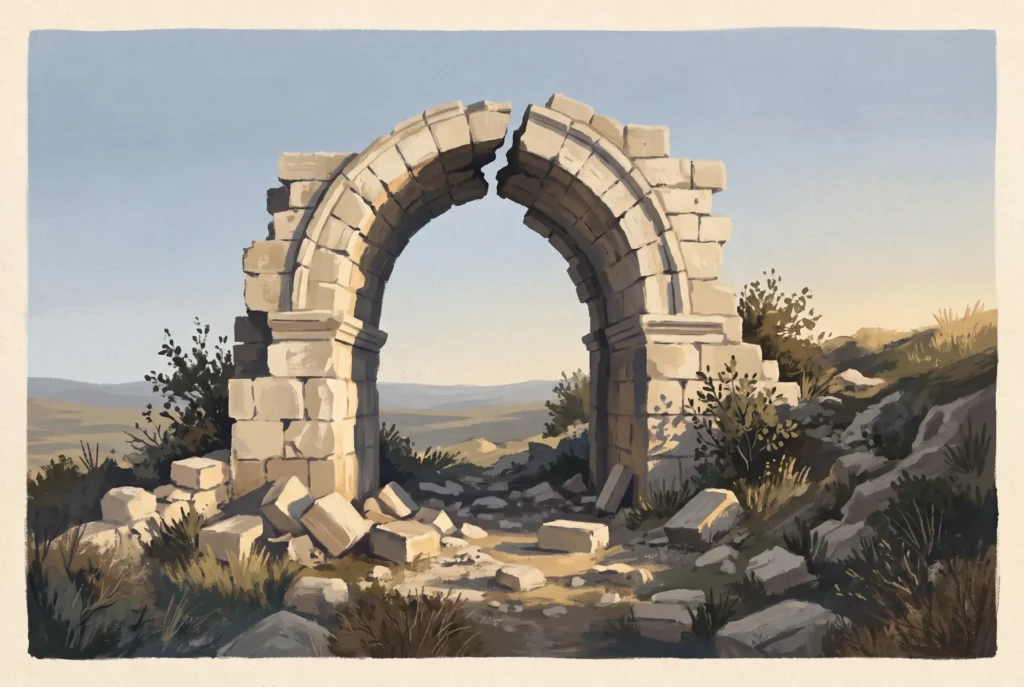
Just before sunset on Sunday, 1 January 1837 (24 Tevet 5597), a magnitude-7 earthquake on the Dead Sea fault system tore through the Galilee and brought the Jewish quarter of Tzfat (Safed) down the hillside. Somewhere between 2,000 and 6,000 people died in the town, depending on whose count you trust, almost every synagogue collapsed, and the survivors’ flight to Jerusalem shifted the centre of Ashkenazi Jewish life in the Land of Israel for good. If you have ever wondered why a city with 500 years of Jewish history has so few buildings older than the 1840s, this is the answer.
Ashkenazi speakers say “Tzfas”; older maps write “Zefat” or “Tsfat”. Whatever you call it, the Old City you walk through today is, physically, a city rebuilt on top of its own ruins.
What happened just before sunset
The shock came at about 4:35–4:45 pm, ten minutes before sunset, lasted around twenty seconds, and was followed by a second strong shock minutes later. Many men were already in the synagogues for Mincha, the afternoon prayer; families were indoors against the cold. It had rained for days, and Safed’s slopes of soft chalk and marl were saturated.
The Jewish quarter sat on the steep northern and western flank of the Citadel hill, terraced so tightly that the flat roofs of one row of houses were the street for the row above. Geologists now believe a landslide carried the upper terraces down onto the lower ones, each row burying the one beneath. The American missionary William McClure Thomson, who reached the town on 18 January, wrote that not a single house in the Jewish half of the town was standing; Ambraseys notes that the Muslim quarter on the southern slope was far less damaged.
People were dug out alive five, six and even seven days later; many more could be heard beneath the rubble and never reached. Rabbi Nissim Zechariah Azulai, grandson of the Chida, was buried with his manuscripts and fellow scholars, dug out alive, and died of his injuries two days later. Rabbi Shmuel Heller, later rabbi of Safed’s Ashkenazim, was buried up to his nose in stones, was bedridden for half a year, and went on to lead the community’s revival for decades.
How big was it? The science
The 1837 event belongs to the series of great earthquakes on the Dead Sea Transform, the plate boundary running from the Red Sea up the Jordan Valley into Lebanon. A 1977 study put the magnitude at 6.25–6.5; Nicholas Ambraseys, re-examining the sources in 1997, argued for a surface-wave magnitude of 7.0–7.1 and a rupture of about 54 km, most likely on or near the Roum fault, a branch running from southern Lebanon toward the Sea of Galilee. Aftershocks continued for months.
Safed was not destroyed by uniquely violent shaking but because the ground under the Jewish quarter failed. Places on unstable slopes, Safed above all, were wrecked; Jish lost its church with the congregation inside. Tiberias lost its walls and some 600–900 people, and a seiche wave swept its lakeshore.
The death toll: why the numbers range so widely
This is where careless pages go wrong, so here is the range with its sources.
- The official Ottoman-era report, as used by Ambraseys (1997) and in Amiran’s catalogue, lists 2,158 dead in Safed and its surrounding villages (1,507 Ottoman subjects, 651 foreign nationals); Amiran’s total for the whole affected area is 4,083.
- The British consul in Beirut reported, on 25 January, about 500 Jewish dead in Safed plus as many Christians and Muslims; a London newspaper two months later carried another account putting the whole toll at 3,000. An early official estimate of 6,000–7,000 for the region, Ambraseys notes, probably left out several districts altogether.
- Jewish sources run higher for Safed itself. The Perushim count about 2,000 Jewish dead, including 200 of their own. The Palestine Exploration Fund’s survey later recorded nearly 6,000 buried under the debris in the town, 4,000 of them Jews, and the National Library of Israel repeats the 4,000 figure. Thomson, who did not count bodies, thought four-fifths of the Jewish half of the town, which he put at about 4,000 people, were under the rubble on the first night.
The honest summary: at least two thousand died in Safed, probably more, and a Jewish community that had made up half or more of a town of 7,000–8,000 lost a large part of its members, by some counts half. Anything more precise is a guess dressed as a fact.
Who was living in Safed in 1837
Three communities shared the hill: the Sephardim, descendants of the exiles from Spain who had made Safed the city of the Arizal and Rabbi Yosef Karo; the Hasidim, arriving since 1777 and led by Rabbi Avraham Dov of Avritch (Ovruch), who had left a forty-year rabbinate in Ukraine; and the Perushim, students of the Vilna Gaon who had come from Shklov in waves from 1808. The Perushim’s leader, Rabbi Yisrael of Shklov, author of Pe’at HaShulchan, happened to be in Jerusalem when the earthquake struck and did not return to live in Safed; he died in Tiberias in 1839. His letter to the Lehren brothers in Amsterdam, printed there in 1837, is among the earliest Jewish accounts of the disaster.
Tzfat tradition tells that as the walls began to move, Rabbi Avraham Dov called out that whoever wanted to live should come and stand beside the Torah. The men ran to the ark; that side held while the rest fell. His chair and reading stand are still in the Avritch synagogue. He urged his followers to stay when most were leaving, raised funds to rebuild, and died in the plague of 1840 (12 Kislev 5601).
What collapsed, and what did not
Nearly every synagogue you enter today is a post-1837 reconstruction.
- The Ari Ashkenazi was destroyed; the inscription over its door records a rebuild twenty years later, around 1857.
- The Ari Sephardi, already damaged in 1759, was wrecked again and restored around 1840 with money from the philanthropist Yitzhak Guetta, whose plaque hangs over the entrance.
- The Abuhav fell except for its southern wall, which holds the arks and the Torah scroll attributed to Rabbi Yitzhak Abuhav. Local accounts say that of the quarter’s synagogues only this wall and the Alsheich stood. Guetta funded a rebuild some years later; the outer walls were rebuilt again, to the original design, in the early twentieth century.
- The Yosef Karo synagogue was destroyed and rebuilt in the years after the earthquake, with Guetta’s money according to local sources, and with help from the Hasidim.
- The Alsheich survived both earthquakes, the only synagogue to do so. Its facade inscription credits a renovation finished shortly before 1837 that added arches and beams; local legend prefers the explanation that Rabbi Alsheich asked that it never have a women’s gallery.
- The Citadel was reduced to a heap of ruins, and its stones were quarried to rebuild the houses below.
Burying the dead
The dead were carried down to the Old Cemetery, the terraced hillside where the Arizal, Rabbi Yosef Karo and the sages of the sixteenth century lie. It is said that graves were dug for more than 2,000 people and no tombstones could be set over them; the earthquake’s victims lie unmarked on the slope among the kevarim you visit today. Thomson described bodies crowded into old vaults and survivors in tents of boards and carpets; his party set up a makeshift hospital by 19 January and left a hired physician in charge.
The exodus to Jerusalem
The decisive consequence came after the funerals. Many Perushim read the catastrophe as a message: they had settled in Safed rather than Jerusalem, and Jerusalem had been spared. The old ban on Ashkenazim in Jerusalem had been eased after 1815, when Rabbi Menachem Mendel of Shklov (d. 1827) re-founded a tiny Ashkenazi community there, and the Safed refugees swelled it. Yisrael Bak, whose Safed printing press had been smashed in 1834, opened Jerusalem’s first Hebrew press in 1841.
By 1857 the Perushim of Jerusalem numbered about 750, and they were among the first settlers of Mishkenot Sha’ananim and Nahalat Shiv’a and the founders of Mea Shearim. Within a decade Jerusalem had overtaken Safed as the largest Jewish city in the Land of Israel. Historians of the Old Yishuv treat 1 January 1837 as the hinge: before it, the Ashkenazi centre was Safed; after it, Jerusalem.
Relief and rebuilding: Montefiore and Guetta
Sir Moses and Lady Judith Montefiore came up the hill on 16 May 1839 and found a town struck three times in five years: plundered in 1834, levelled in 1837, plundered again by Druze rebels in July 1838. On 22 and 24 May Montefiore handed out relief himself, a Spanish dollar to every person over thirteen, two to the blind, with no distinction between Sephardi and Ashkenazi. Rabbi Avraham Dov told him the Ashkenazi congregation had divided its earlier share strictly by each family’s losses. Montefiore also commissioned the first census of the Jews of the Land of Israel that year, which is why the surviving community can be reconstructed household by household. He noted with alarm that people were building hovels directly on the ruins.
The synagogues were rebuilt largely through one man. Yitzhak (Isaac) Guetta, born in Tripoli in 1777, learned trade in Livorno and made his fortune over 57 years as a merchant in Trieste, and paid to restore the Ari Sephardi (1840), Ari Ashkenazi, Abuhav and Yosef Karo synagogues in the years after the earthquake. He settled in Safed himself in 1856, aged 79, died within the year on 8 Shevat 5617 (2 February 1857), and is buried in the Old Cemetery.
1759 and 1834: the blows that came first
Safed had been here before. On 30 October 1759 (9 Cheshvan 5520) an earthquake centred on the Beqaa Valley, which Ambraseys estimated at about magnitude 7.5, set off a landslide on the same western slope. Counts range from about 150 to 2,000 dead; Jewish memory records 140 Jewish dead and a community reduced to about 50 families. Some historians hold that the original Abuhav synagogue stood lower down the hill and was rebuilt on the present site; its scroll was carried to safety during the rebuilding, and legend says the ten men who carried it all died within the year.
Then, on Sunday 15 June 1834 (8 Sivan 5594), just after Shavuot, the Jewish quarter was looted for about a month, 33 days by the usual count, during the peasants’ revolt against Egyptian rule. Synagogues were ransacked, hundreds of Torah scrolls desecrated, the printing press destroyed; Rabbi Yisrael of Shklov smuggled letters to the consuls in Beirut until Druze troops restored order and thirteen ringleaders were executed in Acre. Victims recovered less than a tenth of their losses. The community the earthquake hit was already impoverished and still rebuilding.
What a visitor can still see from before 1837
Very little, which makes it precious.
- The southern wall of the Abuhav synagogue with its three arks: face Jerusalem and you face the one wall that stood through both earthquakes.
- The Alsheich synagogue, the only synagogue building in the city to have come through both earthquakes.
- The Old Cemetery, where the kevarim of the sages predate everything and the unmarked ground between them holds the earthquake’s dead.
- The Citadel: Crusader curtain walls with arrow loops, the Mamluk gate tower with seven-metre-thick walls, the base of Baybars’s round tower, and the rock-cut moat crossing Jerusalem Street.
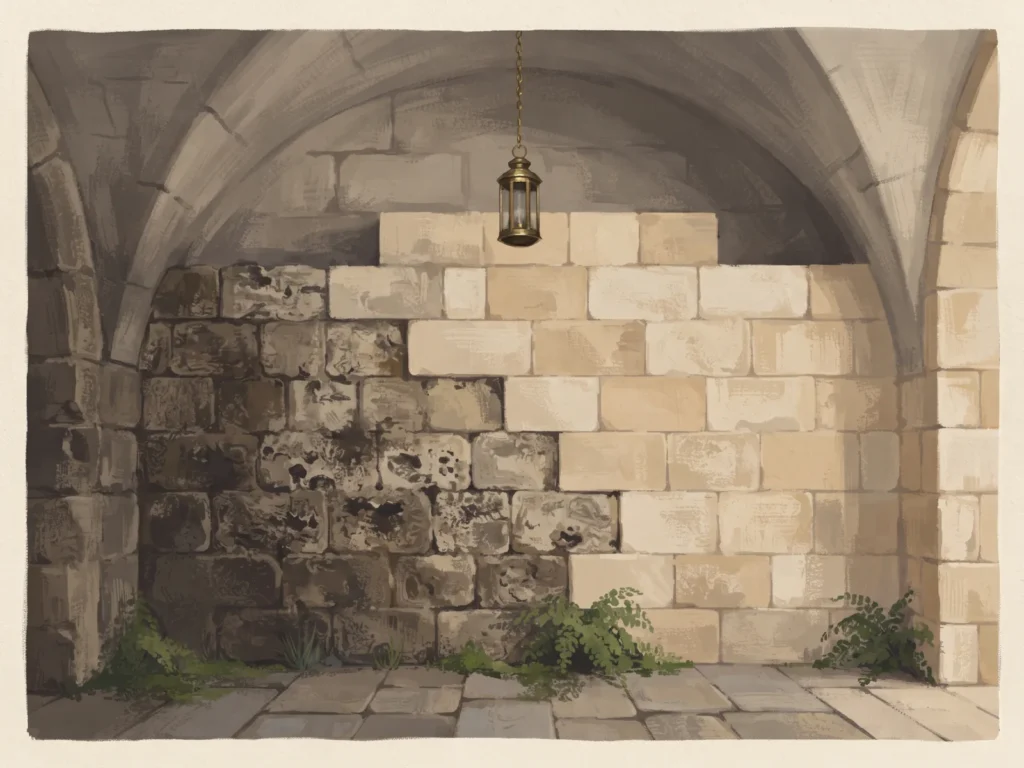
- The lower courses, cisterns and vaulted cellars of many Old City houses. The rebuilders reused foundations, so a plain vault beneath a gallery may be older than anything above it.
How the earthquake explains the Old City’s shape
Look down from the Citadel garden and you can read 1837 in the streets. The synagogue quarter is a tangle of stepped lanes because it was rebuilt fast, by the poor, directly on the slide debris, with stone quarried from the fortress above. Almost every “ancient” synagogue carries an inscription from the 1840s or 1850s, and the summit where a Crusader fortress stood became a garden because nobody dared build there again. Tzfat’s reputation as a city of the sixteenth century is true of its spirit and its kevarim; its stones are mostly children of the nineteenth.
Timeline of Safed’s disasters
| Date | Event | What it did |
|---|---|---|
| 30 Oct 1759 (9 Cheshvan 5520) | Beqaa Valley earthquake, M≈7.5 | Landslide on the western slope; ~140 Jews dead; first Abuhav destroyed; community shrinks to ~50 families |
| 15 Jun – mid Jul 1834 (8 Sivan 5594) | Peasants’ revolt plunder | About 33 days of looting; synagogues ransacked, printing press destroyed, hundreds of scrolls desecrated |
| 1 Jan 1837 (24 Tevet 5597) | Galilee earthquake, M≈7.0 | Jewish quarter slides; 2,000–6,000 dead in Safed by varying counts; all synagogues but Alsheich fall; Perushim leave for Jerusalem |
| 5–7 Jul 1838 | Druze revolt plunder | Three days of looting; ransom demanded; many flee to Acre and Jerusalem |
| Dec 1947 – 11 May 1948 | Siege and Battle of Safed | A Jewish community of roughly 1,500–2,400 (sources differ) blockaded for months; the Citadel falls to the Palmach on the night of 9–10 May; memorial now stands on the summit |
Go deeper: the synagogues of Tzfat, the Yosef Caro synagogue, the Avritch synagogue, the kevarim, the Citadel and other landmarks, the sages of Tzfat including the Arizal and Rabbi Yosef Karo, and the four holy cities. Our audio tours and guided tours point out the pre-1837 stones, and the hilula calendar lists the yahrzeits of the rabbis named here.
Keep reading
Frequently asked questions
When exactly was the Safed earthquake? Sunday, 1 January 1837, in the late afternoon, about ten minutes before sunset. On the Hebrew calendar it was 24 Tevet 5597. Some older sources confuse it with the 1759 quake or misdate it; the 1837 date is fixed by consular letters written within days.
How many people died in Safed in 1837? No one knows precisely. The official report gives 2,158 for Safed and its villages; Jewish traditions and later surveys give 2,000 to 4,000 Jewish dead and up to about 5,000–6,000 in the town overall. Across the whole Galilee and southern Lebanon the figure is usually put at 4,000–7,000.
Which synagogues survived the earthquake? Only the Alsheich synagogue came through intact, thanks to a renovation finished shortly before. The Abuhav’s southern wall with its arks stood while the rest collapsed, and the Bana’a synagogue was partly spared. The Ari Ashkenazi, Ari Sephardi and Yosef Karo synagogues were destroyed and rebuilt between about 1840 and 1857.
Why does Safed have so few old buildings? Because the Jewish quarter slid down the hill in 1837 and was rebuilt in the 1840s on its own debris, using stone quarried from the ruined Citadel. The 1759 earthquake had already destroyed the earlier town. What is old in Safed is below ground, in the cemetery, or on the Citadel summit.
Did the earthquake really move the Jewish centre to Jerusalem? Yes. The Perushim, students of the Vilna Gaon, left Safed for Jerusalem after 1837 in large numbers, reviving an Ashkenazi community that had been banned there for about a century. Within ten years Jerusalem had more Jews than Safed, and the refugees’ descendants founded Mea Shearim and other early neighbourhoods.
Could it happen again? Yes. Safed sits beside the Dead Sea Transform, which produces a large earthquake every century or two; the last damaging one in the region was in 1927. Modern Israeli earthquake building codes exist precisely because of events like 1837. The city’s Old City lanes are beautiful, but they are also a geology lesson.
Sources
- 1837 Galilee earthquake — Wikipedia — date, time, magnitude estimates (Vered & Striem 1977; Ambraseys 1997), Roum fault, Tiberias, Jish, aftershocks, roofs-as-streets description
- Ambraseys, N. (1997), “The earthquake of 1 January 1837 in Southern Lebanon and Northern Palestine”, Annals of Geophysics (PDF) — time (16:35–16:45), Ms 7.0–7.1, 54 km rupture, Roum vs Yammouneh, Safed 2,158 dead, Tiberias 822, landslide site effects, 1759 M≈7.5
- DeadSeaQuake.info — 1837 Safed earthquake summary and source pages — Amiran et al. 1994 official figures (2,158 / 4,083), Katz & Crouvi 2007 landslide model, Citadel collapse, Muslim quarter less damaged, letters of Yisrael of Shklov and Arieh Nee’man
- Thomson, “The Land and the Book”, 1837 earthquake chapter (via DeadSeaQuake.info) — eyewitness details: arrival 18 January, no house standing, rescues after 5–7 days, bodies in vaults, hospital
- Zissil — Safed 1837 Earthquake — 2,000–4,000 range, Mincha timing, wet ground, Abuhav southern wall, Alsheich survival, Avritch legend, Guetta’s four synagogues, Montefiore
- Zissil — Safed 1759 Earthquake — 140 Jewish dead, ~50 families, first Abuhav, ten-carriers legend, Hasidic resettlement
- DeadSeaQuake.info — 1759 Safed and Baalbek earthquakes — 30 October 1759 date, Katz & Crouvi ~150 dead vs Jalfaq 2,000, landslide on western slope
- Perushim — Wikipedia — ~2,000 Jewish dead incl. 200 Perushim, move to Jerusalem, 750 by 1857, Mea Shearim and other neighbourhoods
- National Library of Israel blog — The Epidemic That Brought Jews Back to Jerusalem — Yisrael of Shklov in Jerusalem during the quake, 4,000 Jewish dead figure, Menachem Mendel of Shklov’s community
- Jewish Virtual Library — Historical Sites of Safed — per-synagogue damage, Ari Ashkenazi rebuilt ~1857, Abuhav outer walls early 20th c., Alsheich inscription, cemetery graves for over 2,000 without tombstones, Citadel abandoned
- Jewish Virtual Library — The HaAri Synagogues — Ari Sephardi restored 1840 with Guetta’s money and plaque; Ari Ashkenazi rebuilt 1857
- Jewish Virtual Library — The Alsheich Synagogue — pre-1837 renovation, arches, donor Yehezkel Reuven Menashe, women’s-gallery legend
- Jewish Virtual Library — The Avreitsh Synagogue — legend of the men gathered on one side, Rabbi Avraham Dov’s death in 1840, furnishings
- 1834 looting of Safed — Wikipedia — 15 June 1834 start, 33 days, Torah scrolls, Bak’s press, Yisrael of Shklov’s letters, executions in Acre, <10% recovered
- 1838 Druze attack on Safed — Wikipedia — 5 July 1838, three days, 7,000–8,000 population with Jewish majority in 1837, Jerusalem overtakes Safed within a decade
- Diaries of Sir Moses and Lady Montefiore, vol. 1 (Project Gutenberg) — 16–18 May 1839 arrival, 22 May distribution (a Spanish dollar per person), three blows, hovels on ruins, Rev. A. Dob on dividing relief
- Jerusalem Post — 1837 earthquake feature — consul Chassebaud’s 25 January letter (500 Jewish dead first report), Thomson in Beirut, Yisrael Bak to Jerusalem 1841, Avraham Dov d. 1840
- Hidabroot — The Earthquake That Shook a Nation — 24 Tevet, Rabbi Nissim Zechariah Azulai, Rabbi Shmuel Heller’s survival, Perushim’s interpretation
- JDN — Rabbi Yitzhak Guetta biography (Hebrew) — born Tripoli 1777, Livorno then Trieste, aliyah 1856, died 8 Shevat 5617; Isaac Guetta — Wikipedia — death in Safed 2 February 1857, burial in the Old Cemetery
- Citadel of Safed — Wikipedia and BibleWalks — Safed Citadel — Crusader and Mamluk remains, 1837 destruction, stone reuse, PEF figures (6,000 dead, 4,000 Jews), 1950 garden and memorial
- Operation Yiftach — Wikipedia — 6 May failed assault, 9–10 May attack, Davidka, Jewish population ~1,500–2,400 in 1948