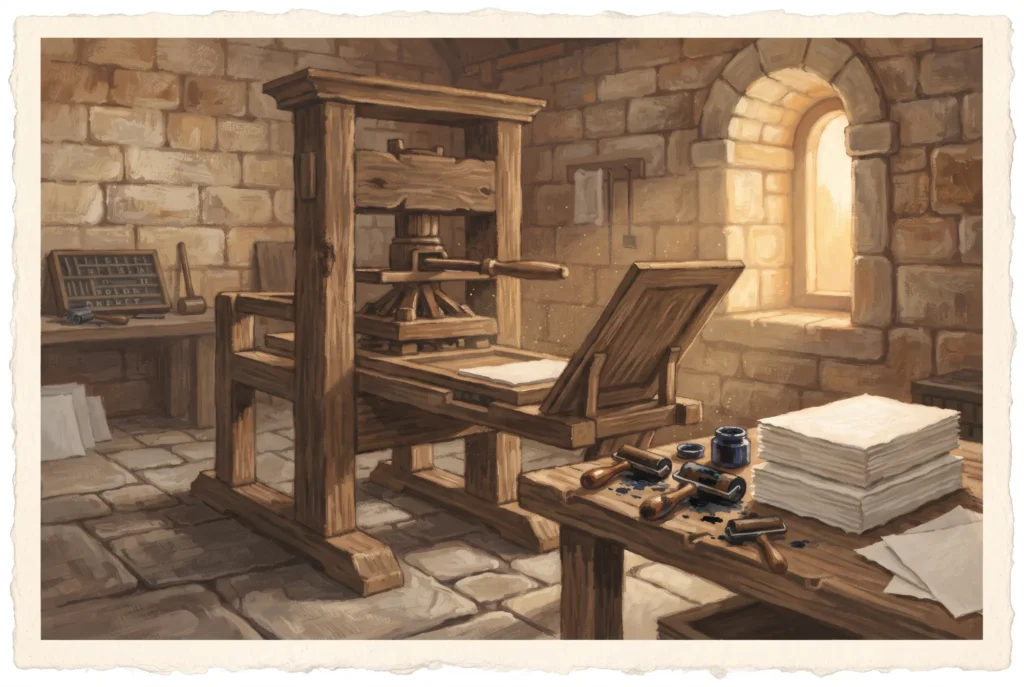
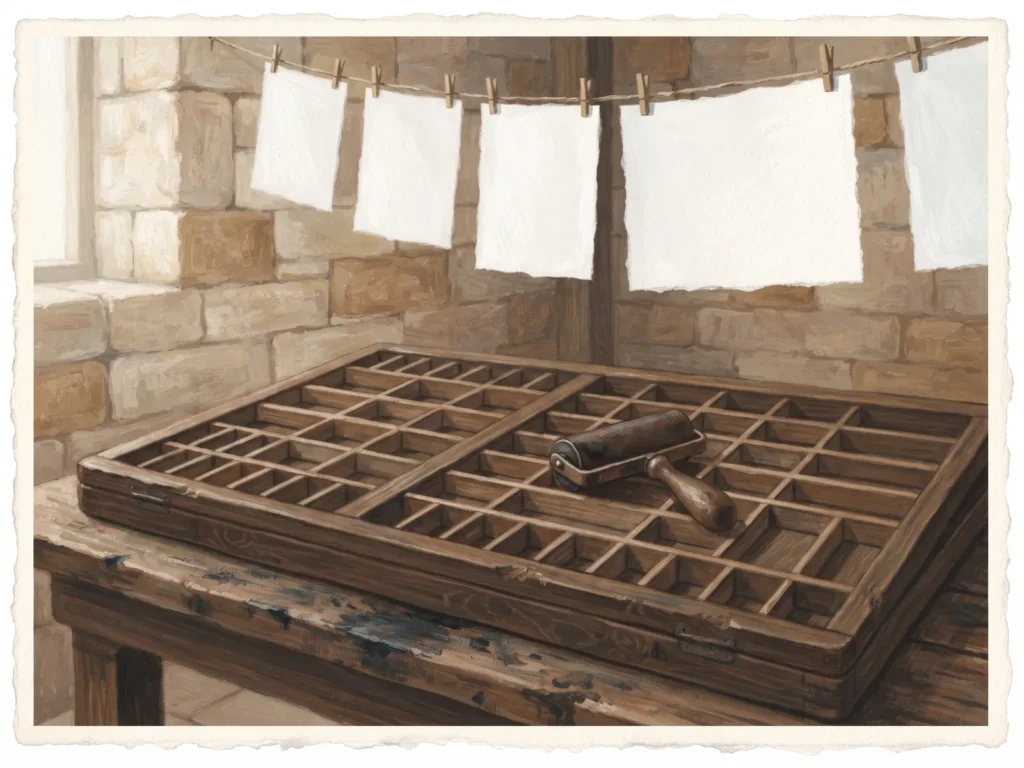
The first book ever printed in the Land of Israel came off a hand press in Tzfat (Safed) in 1577. It was Lekach Tov, a commentary on the Book of Esther by an eighteen-year-old local scholar, Yom Tov Tzahalon, set and printed by Eliezer ben Yitzchak Ashkenazi of Prague with the backing of a Safed resident, Avraham ben Yitzchak Ashkenazi. The press produced just six books in ten years and then fell silent; no Hebrew book would be printed in the Land of Israel again for 245 years.
Why a printer crossed the world to reach Safed
Eliezer ben Yitzchak Ashkenazi was already a veteran when he arrived. Born in Prague around 1530, he ran a Hebrew press in Lublin from 1557 to 1573, printing Talmud tractates whose title pages carry the approbation of the Polish rabbinic leadership. In 1574 he packed his type, ornaments and his son Yitzchak and set out east, pausing for two to three years in Constantinople, where he printed a volume of geonic responsa (1575) and Mekor Baruch, a commentary on Song of Songs (1576).
Then he did something no printer had done before: he carried the equipment up into the Galilee. Safed in 1576 had, by one count, more than 7,000 Jews, dozens of synagogues (32 were registered in 1584), and the densest gathering of Torah scholars in the Jewish world. Rabbi Yosef Karo had finished the Shulchan Aruch there; the Ramak had died in 1570 and the Arizal in 1572; their students were writing furiously. A town full of authors with no press looked like an opportunity.
His partner was Avraham ben Yitzchak Ashkenazi, a Safed man who put up the money and premises while Eliezer set type and printed. Whether the two namesakes were related is unclear; one auction catalogue calls Avraham’s sons Eliezer’s nephews, but the standard histories describe them only as namesakes and business partners who had met in Constantinople.
The first book: a Purim gift from a teenager
Lekach Tov is not what you might expect a landmark to be. Its author, Yom Tov ben Moshe Tzahalon (c. 1558/59–1638), was a youth from a family of Spanish exiles, probably born in Safed, who studied under Rabbi Moshe di Trani (the Mabit) and, sources add, Rabbi Moshe Alsheich. He wrote the commentary at about seventeen or eighteen as mishloach manot, a Purim gift, for his father, and he named it from Proverbs 4:2 (“good teaching”), with a nod to his own name, Yom Tov.
The book is dated by a chronogram from Psalm 30:11 to Rosh Chodesh Sivan 5337, a Friday (27 May 1577 in the modern calendar, 17 May in the Julian calendar then in use); the Library of Congress description records completion on 4 Tishrei 5338, in September 1577. On the reverse of the title page Tzahalon hopes the press will print many books and encourages Safed’s writers to print at home. The final page shows a woodcut of the Temple with a verse from Haggai 2:9, a copy of the device of the Venetian printer Marco Antonio Giustiniani, which Eliezer had already used in Constantinople; his books also carry a crowned two-tailed lion, the symbol of Bohemia, and an arabesque title-page frame designed in Lyon that he had used in Lublin.
Tzahalon went on to become the Maharitatz (also written Maharitz), one of the great halachic authorities of his generation; his first book is the one that made history.
The six books of the Safed press
Everything the press issued was by a Safed author, which tells you how the partners imagined their market. The accepted list, following Yaari and Habermann, is:
- Lekach Tov (1577), Yom Tov Tzahalon, commentary on Esther.
- Kehillat Yaakov (1578), Rabbi Moshe Galante, kabbalistic homilies on Ecclesiastes. Galante, a student of Rabbi Yosef Karo and the Ramak, became head of Safed’s beit din in 1580; the book is thought to preserve some of the earliest recorded teachings of the Ramak. Begun in Cheshvan 1577 and finished in Elul 1578, it took nine and a half months to print.
- Sar Shalom (1579), Rabbi Shmuel Aripul, commentary on Song of Songs.
- Zemirot Yisrael (1587), Rabbi Yisrael Najara, the first edition of his collection, 108 liturgical poems set to Arabic and Turkish tunes; a fuller edition followed in Venice in 1599. Najara’s hymns, above all Yah Ribon, are still sung at Shabbat tables worldwide.
- Mesacheket BaTevel (1587), Najara’s ethical poem on the vanity of the world.
- Baraita de-Rabbi Eliezer (1587); some lists add Midrash Agur to the title.
A caution: Rabbi Moshe Alsheich’s Chavatzelet HaSharon (1563) was once attributed to a Safed press, which would make the press older. Marvin Heller has shown it was printed in Constantinople, at the Jabez press. Alsheich, like most of Safed’s sages, published abroad.
Why the press stopped
Three books in three years, then an eight-year silence. In 1579 Avraham Ashkenazi left for Yemen as a fundraising emissary for the yeshiva of Tiberias, selling Safed books along his route. Eliezer went back to Constantinople, printing Aripul’s Lev Chacham there in 1586, and returned to Safed only in 1587 for a final burst of three titles.
Historians give no single cause, but the sources agree on the ingredients. Safed had no paper mill, poor transport and no distribution network; the established presses of Venice and Constantinople had better type, more experience and reach into every Jewish community. Even the authors who praised the press kept sending their major works to Italy. Eliezer himself is assumed to have died soon after 1587, possibly in an epidemic, and with him the enterprise.
There is an epilogue. His fonts passed to Avraham’s sons, Yitzchak and Yaakov, and in 1605–06 they were used in Damascus, with a printer from Salonika, Avraham ben Mattityahu Bath-Sheba (Basevi), to print Rabbi Yoshiyahu Pinto’s Kesef Nivchar, the first and, until modern times, the only full-length Hebrew book printed in that city. By then the letters were badly worn; the author was displeased with the typography, stopped after Leviticus and sent the rest of his book to Venice. The type of the Holy Land’s first press ended its life in Syria.
How rare the books are
All six Safed imprints are among the rarest Hebrew books. Auction houses call Sar Shalom “exceptionally rare” and estimate Kehillat Yaakov at $25,000–35,000; a Kesef Nivchar, printed with the Safed type, sold for $23,000 in 1998. Lekach Tov was hardly reprinted for four centuries; a facsimile appeared in 1977.
Known copies of Lekach Tov are held by the Library of Congress and the Library of the Jewish Theological Seminary in New York; the National Library of Israel is generally assumed to hold one, though we have not seen its catalogue record. Individual copies occasionally surface at Judaica auctions. Earthquakes, fires and 450 years of hard use account for the rest. The great quake of 1837 levelled Safed’s synagogues and whatever they kept on their shelves, one reason so little of the city’s sixteenth century survives in Safed itself.
245 years without a press
Why did printing not simply return? The same economics held for two and a half centuries: Ottoman Palestine was poor, remote and short of paper, and Jewish publishing was superbly served from Venice, Amsterdam, Constantinople and Livorno. A press in the Holy Land was a statement, not a business.
The man who finally made it was Yisrael Bak (1797–1874), a printer from Berdichev who reached Safed in 1831–32 and in 1832 issued a Sephardi prayer book, the first Hebrew book printed in the Land of Israel since 1587, then in 1833 Leviticus with Rashi and the Chida, the first printed book of the Bible from the Holy Land. His luck was Safed’s luck: the 1834 peasants’ revolt wrecked his press and left him stabbed in the foot; the 1837 earthquake devastated his shop; the 1838 riots (Druze, by most accounts) finished off press and his farm on Mount Meron. He moved to Jerusalem and in 1841 established the first Hebrew press there, re-equipped with a press donated by Moses Montefiore in 1843.
What a visitor can see today
Honestly, nothing physical. No building is identified as the printing house, no plaque marks it, and the earthquakes of 1759 and 1837 rebuilt the Old City from the ground up. There is no museum copy of Lekach Tov in Safed.
What you can do is walk the streets the printers worked in. The synagogues of Rabbi Yosef Karo and the Ari Sephardi, the kevarim of Karo, the Ramak, the Arizal and Rabbi Shlomo Alkabetz in the Old Cemetery, and the alleys between them are the ground on which Eliezer Ashkenazi set type for the books of their students. Tzahalon, Galante and Najara all walked these lanes; a guided tour or our things to do in Tzfat page will take you through them. Stand at the overlook above the cemetery and you are looking at the Safed of 1577. Then look for a digital scan online and read the words a teenager wrote for his father’s Purim.
Ashkenazi speakers call the city “Tzfas”; older maps write “Zefat” or “Tsfat”. The press’s title pages wrote simply צפת.
Timeline
- 1557–1573 Eliezer ben Yitzchak Ashkenazi prints in Lublin.
- 1574 Leaves for Constantinople with type, ornaments and his son.
- 1576–77 Arrives in Safed; partnership with Avraham ben Yitzchak Ashkenazi.
- 1577 Lekach Tov (Tzahalon), first book printed in the Land of Israel.
- 1578 Kehillat Yaakov (Galante).
- 1579 Sar Shalom (Aripul); Avraham leaves for Yemen; press halts.
- 1586 Eliezer prints in Constantinople again.
- 1587 Zemirot Yisrael, Mesacheket BaTevel, Baraita de-Rabbi Eliezer: the last Safed books.
- c. 1588 Eliezer dies (assumed; no record).
- 1605–06 Kesef Nivchar printed in Damascus with the Safed type, held by Avraham’s sons.
- 1832 Yisrael Bak revives Hebrew printing in Safed.
- 1837 Earthquake destroys Bak’s shop; 1838 he leaves.
- 1841 Bak founds Jerusalem’s first Hebrew press.
- 1977 Facsimile of Lekach Tov marks the 400th anniversary.
Keep reading
Frequently asked questions
What was the first book printed in Israel? Lekach Tov, a commentary on the Book of Esther by Rabbi Yom Tov Tzahalon, printed in Safed in 1577 by Eliezer ben Yitzchak Ashkenazi of Prague. It is the first book printed in the Land of Israel in any language; its chronogram gives Rosh Chodesh Sivan 5337 (27 May 1577, modern calendar), and the Library of Congress records completion on 4 Tishrei 5338 (September 1577).
Who founded the first printing press in Safed? Two men named Ashkenazi: Eliezer ben Yitzchak, an itinerant printer who had previously worked in Lublin and Constantinople, and Avraham ben Yitzchak, a Safed resident who financed the venture. Eliezer set and printed the books; Avraham supplied the money and later sold copies on a fundraising trip to Yemen.
How many books were printed in Safed in the 16th century? Six, all by Safed authors: three in 1577–1579 and three in 1587. They include works by Rabbi Moshe Galante, Rabbi Shmuel Aripul and the poet Rabbi Yisrael Najara, whose Zemirot Yisrael (1587) contains hymns still sung every Shabbat.
Why did Hebrew printing in Safed stop? No single cause is recorded. Historians point to the lack of paper and distribution in Ottoman Galilee, competition from the superior presses of Venice and Constantinople, the departure of the financing partner for Yemen in 1579, and the probable death of Eliezer Ashkenazi around 1588. Printing did not return to the Land of Israel until Yisrael Bak’s press in Safed in 1832 and Jerusalem in 1841.
Can I see the original 1577 book in Safed? No. There is no copy, museum or marked site in Safed. Surviving copies are held in research libraries such as the Library of Congress and the Jewish Theological Seminary (and, presumably, the National Library of Israel), and digital scans are available online. Visitors can instead walk the Old City and the Old Cemetery, where the authors of the Safed books lived, taught and are buried.
Sources
- Jewish Virtual Library, “First Book in the Holy Land” (from A. J. Karp, Judaic Treasures of the Library of Congress) — printers (namesakes who met in Constantinople), arrival 1576, completion 4 Tishrei 5338, Giustiniani Temple woodcut, six books, LoC copy, 245-year gap to Bak 1832.
- Seforim Blog, “Lekah Tov – What’s in a Name?” — chronogram (Psalm 30:11) Friday Rosh Chodesh Sivan 5337 = 27 May 1577, age 17–18, Purim gift, Proverbs 4:2, Tzahalon’s encouragement to Safed authors, Giustiniani device already used in Constantinople, JTS image credit.
- Marvin J. Heller, “Early Hebrew Printing from Lublin to Safed: The Journeys of Eliezer ben Isaac Ashkenazi” (Jewish Culture & History 4:1, 2001) — Lublin and Constantinople dates, Mekor Baruch, Bohemian lion and Lyon arabesque frame, the full list of six Safed books with dates, Kehillat Yaakov nine and a half months, Zemirot Yisrael 108 piyyutim, Yemen, the 1579–1587 hiatus, Lev Chacham 1586, death assumed after 1587, Alsheich’s Chavatzelet HaSharon printed in Constantinople (Jabez press), Safed fonts passed to Avraham’s sons and used by Bath-Sheba for Kesef Nivchar (worn letters).
- Sotheby’s, Kesef Nivhar, Damascus 1605–06 (Marx collection, 2019) — printers Abraham ben Shabbetai Mattathias Basevi and Isaac and Jacob sons of Abraham Ashkenazi, worn fonts, printing stopped after Leviticus and completed in Venice 1621, only full-length Hebrew book printed in Damascus.
- Wikipedia, “Israel ben Moses Najara” — Zemirot Yisrael first published Safed 1587, 108 poems, Venice edition 1599; Mesacheket BaTevel Safed 1587.
- Encyclopaedia Judaica, “Eliezer ben Isaac” (via Encyclopedia.com) — biography; bibliography of Habermann (Toledot ha-Defus bi-Tzefat, 1962) and Yaari (Ha-Defus ha-Ivri be-Artzot ha-Mizrach, 1937).
- Shlomo Pereira, “1577: An itinerant rabbi brings the Hebrew printing press to the Land of Israel” (Times of Israel blogs) — Prague birth c. 1530, Lublin 1557–1573, six titles, Yemen mission, plague.
- Shlomo Pereira, “1577: R. Yom Tov Tzahalon and the first book ever printed in the Land of Israel” — Tzahalon biography, 1977 facsimile.
- Wikipedia, “Yom Tov Tzahalon” — dates c. 1559–1638, teachers di Trani and Alsheich, responsa Venice 1694.
- COJS, “1577 The First Printing Press in the Middle East – Safed” (M. Avi-Yonah) — son Yitzchak of Prague, three years in Constantinople, 1577–1580 and 1587 output, Yemen.
- Kestenbaum & Co., Kohelet Yaakov, Safed 1578 (Auction 11, lot 40) — Galante’s book, Lublin type and ornaments, beit din 1580, $12,000 hammer.
- Kestenbaum & Co., Sar Shalom, Safed 1579 (Sale 80) — “exceptionally rare”, Yaari Safed 3, Vinograd Safed 3.
- Genazym Auctions, Kehillas Yaakov, Tzfas 1578 — estimate $25,000–35,000, Ramak’s early teachings.
- Kestenbaum & Co., Kesef Nivchar, Damascus 1605 (Auction 6, lot 548) — printed by Yitzchak and Yaakov, sons of Avraham Ashkenazi, with Safed type; $23,000.
- Jewish Virtual Library, “Hebrew Press Returns to the Holy Land” — Bak 1831/32 prayer book, Leviticus 1833, 1834 revolt, 1837 quake, 1838 Druze revolt, Jerusalem 1841, 245-year gap.
- Wikipedia, “Yisrael Bak” — 1797–1874, stabbed defending the press 1834, Montefiore press 1843.
- Incunabula thread on the Safed press — 7,000 Jews in 1576, 32 synagogues in 1584, Damascus 1605.